
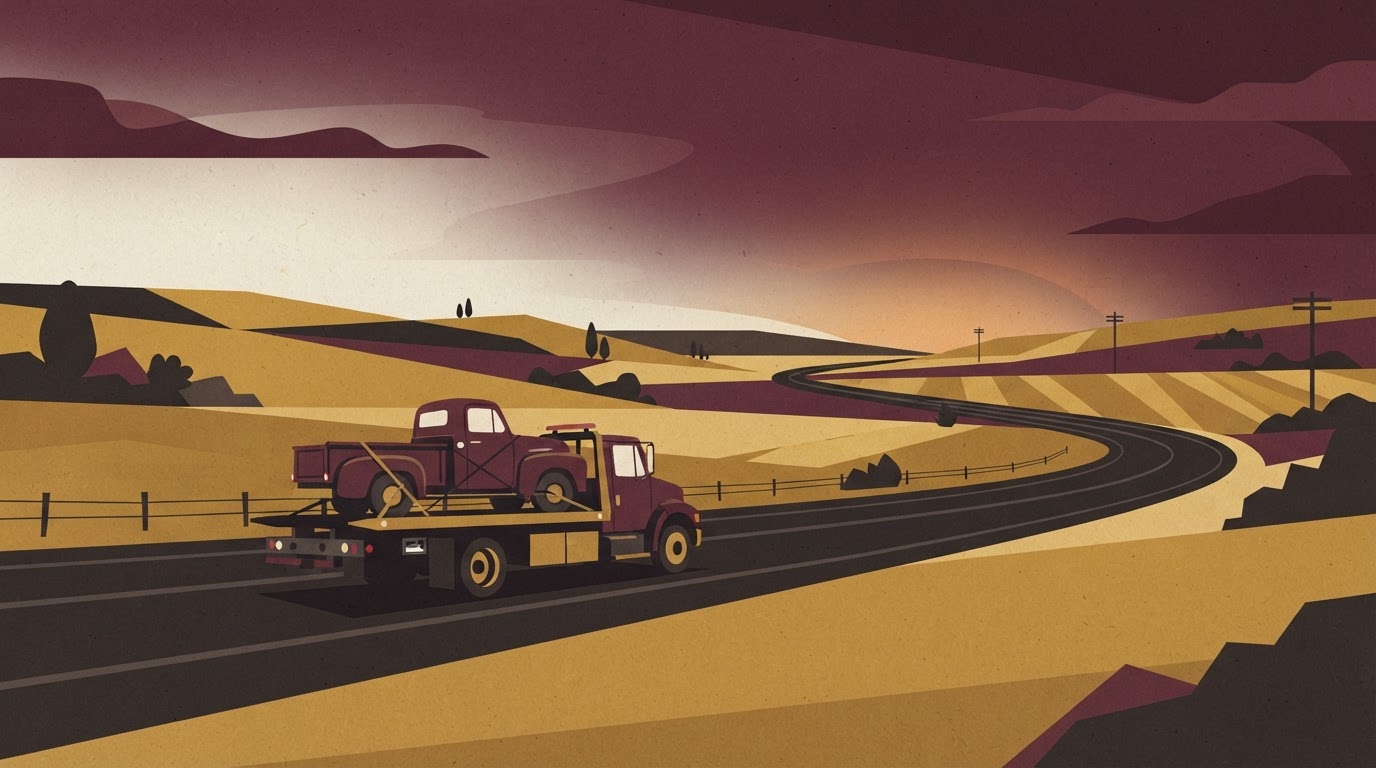
Why rural vehicle repairs cost more than the labor and parts on the invoice
When the quote comes in at a certain number, that’s not really what the repair costs you. It’s just what the shop charges for parts and labor. Everything else—the tow, the time off work, the rental car you didn’t budget for, the gas burned driving back and forth to check on your truck—doesn’t show up on that piece of paper. But it comes out of your pocket just the same.
In a city, a breakdown might mean a short tow and a bus ride home. Out here, a breakdown can mean your vehicle sits forty miles from the nearest shop that can actually work on it, and getting it there and getting yourself home again turns into its own small project. That gap between the invoice total and the real cost is the hidden tax of living where you live. It’s worth putting a number on it, because you can’t plan for a cost you’ve never bothered to add up.
Tow truck math: mileage charges and how fast they add up outside town
Tow companies typically charge a hook-up fee plus a per-mile rate, and that per-mile rate usually kicks in the moment the truck leaves its own yard, not from where your vehicle broke down. So if the tow company is based twenty miles from you, and the shop is another thirty miles past that, you may be paying mileage on a stretch of road your vehicle never even needed to travel.
This is where distance quietly compounds. A breakdown five miles from a shop in a bigger town might cost you a flat, modest fee. The same breakdown out on a county road, with the tow truck coming from one direction and the shop sitting in another, can rack up mileage charges that rival the cost of the repair itself. Weekend and after-hours calls often carry a premium too, and if you’ve ever broken down on a Saturday evening, you know that’s rarely a coincidence—equipment tends to fail when you’re using it hardest, which for a lot of us means weekends and harvest season.
If you belong to a roadside assistance program through your insurance or a membership club, check the actual mileage cap before you need it, not after. Plenty of these plans cover a flat distance that sounds generous until you measure the real distance between your driveway and the nearest qualified shop. Knowing that number ahead of time means one less surprise on a day that’s already gone sideways.
Lost income from missed workdays when your only vehicle is the one in the shop
For a lot of households in town, a car in the shop is an inconvenience. Out here, it can be a work stoppage. If you’re a tradesperson who needs your truck to haul tools and materials, a rancher who needs it to check fence and move stock, or anyone whose job starts with a drive to a job site, the vehicle isn’t just transportation—it’s part of your income-generating equipment. When it’s gone, so is your ability to earn on a normal day.
This cost rarely gets counted because it doesn’t arrive as a bill. It arrives as a day you didn’t get paid, a job you had to reschedule, or a client who called someone else because you couldn’t make it out. If you’re paid hourly or by the job, that lost day has a real dollar figure attached to it, and it should be added to whatever the shop quotes you. A repair that “only” costs a few hundred dollars in parts and labor can easily double once you count a missed day or two of work on top of it.
If you have a spouse, neighbor, or family member who can lend a vehicle for a day, that arrangement is worth more than most people give it credit for. It’s also worth having that conversation before you need it, so it’s not one more scramble on top of an already bad day.
Loaner and rental car scarcity in small towns and what it costs to go without
In a city, a loaner car or a rental is usually a phone call away. In small-town America, the shop might not offer loaners at all, and the nearest rental counter could be as far away as the mechanic himself. Some rural rental offices only keep a handful of vehicles on the lot, and during busy seasons—planting, harvest, hunting season, holiday travel—those vehicles can be gone before you even call.
Even when a rental is available, getting to it is its own errand. Someone has to drive you there, or you have to arrange a ride, which means you’re now coordinating two vehicles and two schedules instead of one. And the cost of the rental itself, stacked on top of the repair and the tow, is exactly the kind of expense that turns a manageable bill into a stressful one.
This is a good argument for knowing, before anything breaks down, what your actual options are within reasonable driving distance. A short list of who has loaners, who rents vehicles nearby, and which neighbors have offered to help in a pinch can save you an hour of panicked phone calls when you’re standing on the side of the road.
Building a repair fund that accounts for distance, not just parts
Most advice about car repair savings assumes you’re saving for parts and labor. Out here, that’s only part of the number. A more honest repair fund adds in a reasonable estimate for towing, a day or two of lost income if your work depends on the vehicle, and a rental or loaner cost if you don’t have a backup vehicle sitting in the yard.
You don’t need to calculate this to the dollar. A rough padding on top of your usual repair savings—enough to cover a tow from the farthest shop you’d realistically use, plus a couple days without income—gets you most of the way there. The point isn’t precision. It’s making sure that when the bill actually comes due, you’re not caught short by the parts of it nobody put on paper.
It also helps to think about this fund separately from your general emergency savings. A breakdown fund that’s specifically sized for the real, full cost of a rural repair means you’re not raiding money set aside for something else, and you’re not stuck making a bad decision under pressure because the number in front of you is bigger than the number you saved for.
Questions to ask a shop before committing to a long-distance repair
Before you agree to have your vehicle towed any real distance, a few questions can save you money and aggravation. Ask whether the estimate includes a full inspection or just a diagnosis of the obvious problem—a vehicle that’s already forty miles from home is not the time to find out it needs a second trip for something they missed. Ask how long the shop expects the repair to take, and whether that estimate holds up if parts have to be ordered, since rural shops often wait longer on parts than shops with bigger regional suppliers nearby.
Ask if they offer a loaner, a shuttle, or know of any local rental option, and ask directly whether the mileage on your tow is calculated from the tow company’s yard or from wherever your vehicle actually is. Finally, ask what happens if the repair costs more than the estimate—get a number they’ll call you at before doing any extra work, so you’re not stuck deciding between an unexpected bill and a second tow to somewhere else.
None of these questions guarantee a cheaper repair. But they turn a vague, distant transaction into something you can actually plan around, which out here, with the nearest shop an hour away, is worth almost as much as the repair itself.
