
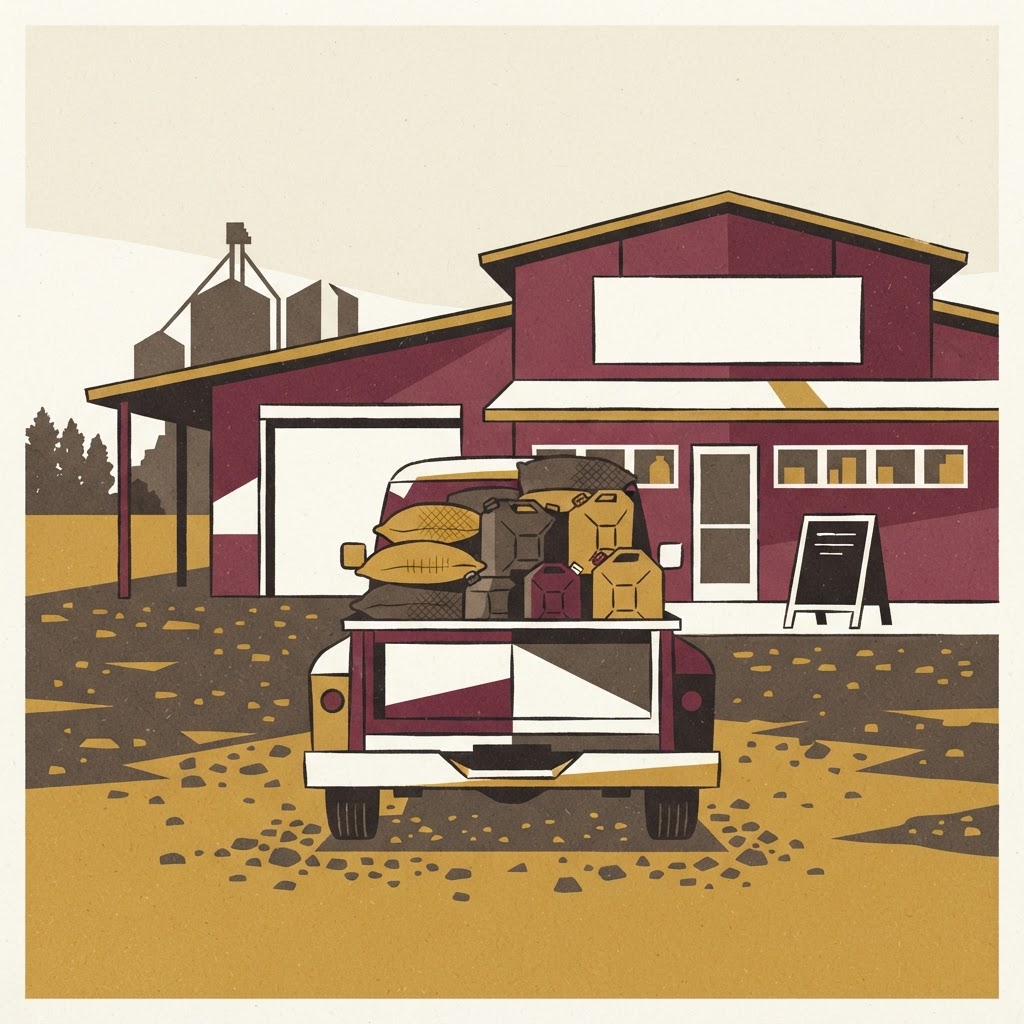
You know the drive before you even put the truck in gear. Forty-five minutes to the co-op, maybe more if the gravel’s washboarded or you get stuck behind a grain cart. You go for a few bags of mineral or a tank of diesel, and by the time you’re back home, half the morning’s gone. The receipt in your hand tells you what the feed cost. It doesn’t tell you what the trip cost, and that’s the number that quietly eats into a lot of rural operating budgets.
Mapping the real cost of a co-op run: fuel, truck wear, and hours away from the operation
Start with the obvious one: fuel. A round trip to town and back isn’t free just because you’re already driving a truck you own. Every mile burns diesel or gas, and at the price per gallon you’re paying these days, a longer haul can turn a “quick errand” into a real line item. Multiply that by how many trips you make in a month, and it adds up faster than most people track.
Then there’s wear on the truck itself. Tires, brakes, oil changes, the eventual transmission work – none of that shows up on the day of the trip, but it’s happening every time you put miles on gravel and highway hauling feed or fertilizer. If you’re not setting aside something for vehicle upkeep tied to how much driving your operation actually requires, you’re going to get surprised by a repair bill that feels random but really isn’t.
The cost that’s easiest to overlook is your own time. An hour and a half round trip, plus loading, plus waiting if the co-op’s busy, is real time you’re not spending on chores, repairs, or anything else that keeps the operation running. On a small crew – or a one-person operation – that lost time has a cost even if no invoice ever shows up for it. Some people find it helps to put a rough hourly value on their own labor, just so the “free” trip stops looking free on paper.
Why “buying in bulk to save a trip” can backfire on cash flow for smaller operations
Once you’ve calculated what a trip actually costs, the instinct is obvious: buy more each time so you don’t have to go back as often. That’s not wrong, exactly, but it can get you into trouble if you’re not careful about cash flow.
Buying six months of feed at once ties up cash that might be needed for something else – a vet bill, a part that breaks, seed for next season. Bulk buying makes sense when you have the storage for it, the cash flow to absorb the upfront hit, and inputs that don’t degrade or lose value sitting around. It backfires when you’re stretching to make a bulk purchase “worth the drive” and then find yourself short on cash for something that comes up two weeks later.
It’s worth asking honestly: are you buying this much because it’s the right amount for your operation right now, or because you don’t want to make the drive again next month? Those are two different decisions, and only one of them is really about your bottom line.
How delivery minimums and fuel surcharges from suppliers factor into the true price of inputs
A lot of co-ops and suppliers offer delivery, which can save you the drive – but it comes with its own math. Delivery minimums mean you often have to order more than you need just to qualify for free or reduced delivery, which puts you right back into the bulk-buying cash flow question. And fuel surcharges, especially when diesel prices climb, can quietly add a percentage onto every delivered order that you don’t see until the invoice.
None of this means delivery is a bad deal. For a lot of operations, especially during planting or calving season when time away from the place is expensive in its own right, paying a delivery fee is cheaper than the hours lost making the trip yourself. But it’s worth actually comparing the delivered price, surcharges included, against your own true cost of driving – fuel, truck wear, and your time – rather than assuming one option is automatically cheaper than the other. The answer changes depending on the season, the price of diesel, and how far you actually are from town.
Comparing the math of fewer, larger trips versus more frequent, smaller ones
There’s no single right answer here, because it depends on your storage, your cash flow, and how far you’re driving. But it helps to actually run the comparison instead of defaulting to habit.
Fewer, larger trips mean less total fuel spent on driving and less time lost to the road over a season. But they require more storage space, more upfront cash, and carry more risk if something changes – prices drop after you’ve bought, or you end up with more than you need because your herd size or acreage shifted.
More frequent, smaller trips keep your cash flow tighter and your storage needs lower, but they cost more in cumulative fuel and time, and they mean more days where a chunk of your morning or afternoon is gone. For operations closer to town, this trade-off is a lot more forgiving. For operations an hour or more out, the frequent-trip approach can quietly become one of the bigger hidden costs in the budget.
The honest way to compare is to actually write out both scenarios for a season – your typical input needs, the number of trips each approach would take, and the fuel, time, and storage cost of each. It’s not exciting work, but it’s the kind of five-minute exercise that can shift how you buy for the next six months.
Building input costs into a seasonal budget instead of treating each run as a surprise expense
A lot of rural operations budget for inputs the way they budget for weather – as something that happens to them rather than something they can plan around. Feed, fuel, and fertilizer costs get treated as they come up, trip by trip, instead of being mapped out ahead of the season.
Building a seasonal budget doesn’t mean predicting exact prices months out – nobody can do that reliably. It means laying out roughly how many co-op runs a season is likely to require, what that means for fuel and time, and setting aside money ahead of the busiest input periods so a run to town doesn’t come as a cash flow shock in the middle of calving or planting. Even a rough seasonal map – “this many trips in spring, this many in fall” – gives you something to check your actual spending against, instead of finding out three months later that input runs quietly outpaced what you’d set aside.
When it makes sense to split trips or coordinate with neighbors to spread the cost
One of the oldest tricks in rural life is still one of the best: go halves on a trip with a neighbor. If you and the operation down the road are both due for a co-op run, splitting fuel cost, sharing a delivery minimum, or just taking turns driving can cut the real cost of each trip nearly in half without either of you changing what you buy.
This works especially well for delivery minimums – two smaller orders combined can clear a threshold that neither one would hit alone, and you split the surcharge or avoid it altogether. It also works for the simple driving trip, especially if you’re hauling a trailer anyway and have room for someone else’s order.
It takes a bit of coordination and trust, and it’s not something that works for every input or every relationship. But for routine items – mineral, common feed, fuel – it’s often the simplest way to shrink the real cost of distance without changing a single thing about how you run your operation.
