
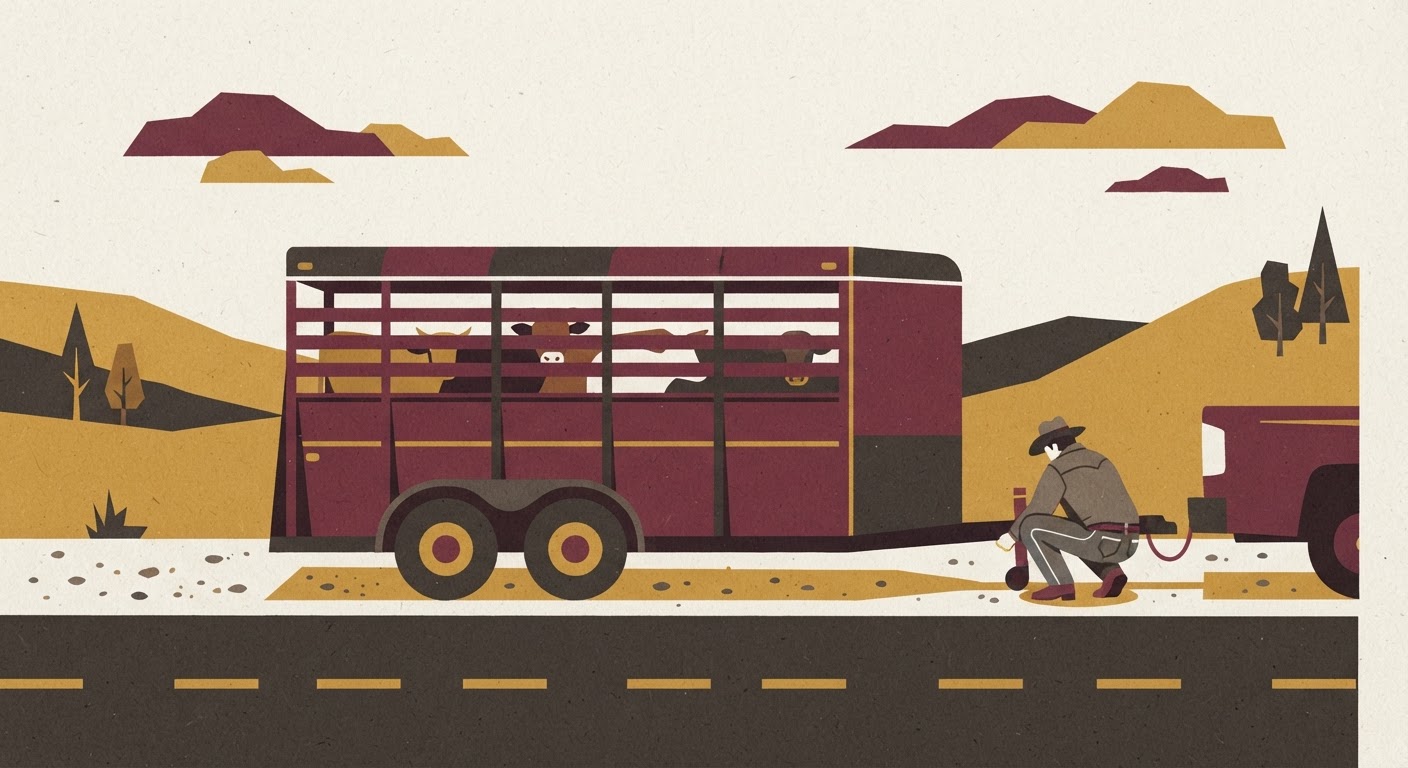
Most ranchers we talk to have their bases covered on paper. There’s a farm policy for the barn, equipment, and outbuildings. There’s an auto policy for the truck. But ask what happens if that stock trailer rolls on a two-lane highway between the ranch and the sale barn, and you’ll often get a long pause. That gap — the moving middle of the trip — is where a lot of livestock owners find out the hard way that “covered” doesn’t mean what they thought it meant.
Why standard auto and farm liability policies often exclude livestock in transit
Your personal auto policy is built around people and property damage on the road — your truck, the other driver’s car, medical bills if someone’s hurt. It was never designed to think about the animals riding behind you. Livestock in the trailer is usually treated as cargo, and cargo is frequently excluded or capped at a token amount that wouldn’t cover one good bred heifer, let alone a trailer load.
Your farm liability policy has the opposite blind spot. It’s built to protect the operation at home — the barn, the corrals, injuries that happen on your land. Once that gate closes behind the trailer and you pull onto the county road, you’ve often left the geographic and operational boundaries the farm policy was written to cover. Insurers draw that line because the risks change the moment you’re hauling: highway speed, other traffic, weather, road conditions, and the simple physics of several thousand pounds of live animal shifting weight in a moving trailer.
The result is a coverage sandwich with a hole in the middle. Home and barn: covered. Truck and driver: covered. Cattle in the trailer on the way to the sale: maybe not, and you often don’t find out until you’re filing a claim instead of reading a policy.
Commercial hauler’s coverage vs. private carrier exemptions for ranchers hauling their own stock
If you hire a commercial trucking outfit to haul your cattle, that company is typically required to carry its own liability and cargo coverage, and federal rules governing motor carriers apply to them in ways that matter for accountability after a wreck. That’s a real layer of protection, but it’s their coverage, not yours, and it usually only kicks in for damage the carrier is legally responsible for causing — not for the value of your animals lost along the way, unless you’ve specifically arranged cargo coverage for that load.
Many ranchers, though, haul their own stock with their own truck and trailer, and this is where “private carrier” rules come in. Hauling your own animals to your own sale, your own pasture, or a show generally falls under exemptions meant for private, non-commercial use — which sounds like it should simplify things, but it actually means fewer built-in protections apply to you automatically. You’re not a commercial carrier with cargo insurance requirements hanging over you; you’re a private individual whose auto and farm policies were never built with a loaded trailer in mind. The exemption that keeps you out of certain commercial trucking regulations doesn’t come with a coverage safety net to replace what you’re exempt from.
What happens financially when a trailer wreck injures or kills livestock on a rural highway
Picture the ordinary version of this: a blown tire, a patch of ice, a deer in the road at dusk. The trailer jackknifes or rolls. Best case, the animals are shaken up and a vet bill follows. Worse case, you’ve lost several head outright, and the survivors need veterinary attention, re-penning, and transport to finish the trip you started.
Now add up what’s actually on the line: the replacement value of the animals, the vet costs, the cost of a tow and trailer repair or replacement, possible liability if the wreck involved another vehicle, and the lost time and fuel of redoing the trip. If those cattle were headed to a sale with a set date, there’s also the lost opportunity of missing that specific sale window and the price swings that come with rescheduling. None of that shows up neatly on either the auto or farm side of your coverage if livestock-in-transit was never addressed. It becomes an out-of-pocket loss at exactly the moment you also have a wrecked truck or trailer to deal with.
Coverage options: livestock mortality in transit, trailer interchange, and hired hauler liability
The good news is that this gap has a name in the insurance world, and there are products built specifically to close it. Livestock mortality coverage written to include transit will cover the value of an animal that dies as a direct result of the trip itself — a wreck, a rollover, extreme heat, or another transit-specific cause — rather than only covering death on the home place.
Trailer interchange coverage matters if you ever haul someone else’s trailer or lend yours out, which is more common than people think during busy sale or show season. It addresses physical damage to a trailer that isn’t yours, which your own auto policy typically won’t touch.
Hired hauler liability, or contingent cargo coverage, is worth asking about if you regularly pay someone else to move your animals. It’s meant to fill the gap between what the hauler’s own policy covers and what you’d actually be out if something happened to your animals in their care. None of these are exotic products reserved for big feedlots — they’re available to small operations, but almost never offered unless you ask.
Questions to ask your agent before sale day, show season, or a long-distance move
Before you load up for a sale, a fair, or a move across the state, it’s worth having a short, specific conversation with your agent rather than assuming your existing policies stretch to cover the trip. Ask directly whether your farm policy covers livestock once they leave your property. Ask whether your auto policy has a livestock or cargo exclusion, and if so, what the dollar cap is if any coverage exists at all. Ask what changes if you’re hauling your own animals versus hauling for a neighbor as a favor, since that can shift how a claim is viewed. And if you use a hired hauler, ask to see proof of their cargo coverage rather than taking their word for it.
These are five-minute questions that can save you a very long, very expensive afternoon on the side of the highway. Agents who work with rural clients regularly have seen this gap plenty of times and can usually point you to an endorsement or short-term rider rather than a whole new policy.
Documenting animal value and health before the trip in case you need to file a claim
Whatever coverage you end up with, a claim only goes smoothly if you can show what you had before the wreck. Keep current photos of the animals being hauled, ideally taken the same day or within a day or two of loading. Keep vet records, weight tickets, breeding papers, and any recent sale comparisons for similar animals, since insurers will want evidence of value, not just your word for it. If you’re hauling to a specific sale, keep the entry paperwork and expected sale weight on hand too.
None of this takes long, and most of it you’re probably already generating as part of normal recordkeeping. The difference is having it organized and accessible before you need it, not scrambled together at a kitchen table after a bad night on the highway. A little paperwork now is a lot cheaper than an argument with an adjuster later.
