
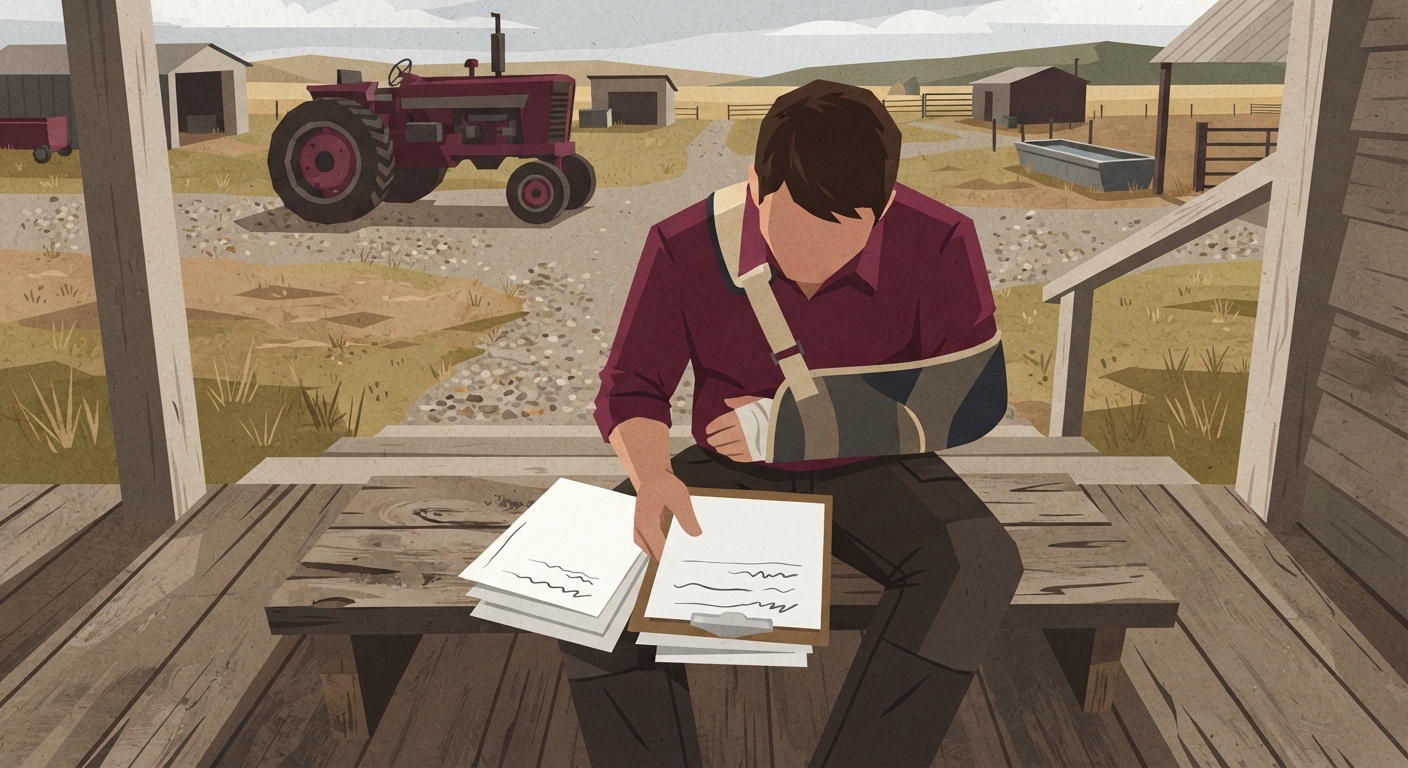
If you’ve ever tried to get a disability insurance quote and felt like the agent on the phone had no idea what to do with “I run 200 head of cattle and fix my own equipment,” you’re not imagining it. Most disability policies were built with office workers in mind. The underwriting questions assume a desk, a chair, and a boss who’ll let you work from home with your arm in a sling. None of that applies when your job is climbing into a hay loft, wrestling calves, or crouching under a truck all day.
Insurers price disability coverage based on risk, and manual labor is riskier by every measure they use. Backs, shoulders, and knees wear out faster. Injuries happen more often and heal slower. And because so much of ranch and trade work is physical rather than cognitive, there’s often no lighter-duty version of the job to shift into. An office worker with a bad back can still answer emails. A rancher with a bad back often can’t do the job at all, which is exactly the scenario that scares insurance companies the most. That fear shows up in higher premiums, narrower definitions of “disabled,” and sometimes outright denial of coverage for people in the highest-risk occupation classes.
It’s also just harder to find someone selling these policies in a lot of rural areas. Agents who specialize in disability insurance tend to cluster where the client base is white-collar and steady-income. Finding one who understands seasonal cash flow and calloused hands for a living takes some digging, but it’s worth the effort, because the policy you end up with matters more than almost any other piece of paper in your financial life.
“Own occupation” vs “any occupation” policies and why the difference matters for manual labor
This is the single most important distinction in the entire disability insurance conversation, and it’s the one salespeople gloss over the fastest because the cheaper option sounds fine until you actually need it.
An “own occupation” policy pays out if you can’t do the specific work you were doing before you got hurt. If a torn rotator cuff means you can no longer climb onto machinery or handle livestock, you get paid, even if you’re technically capable of sitting at a desk somewhere answering phones.
An “any occupation” policy is a much higher bar. It only pays if you can’t do any job reasonably suited to your education and experience. Under that definition, an insurance company can argue that you’re capable of some kind of work, maybe a parts counter, maybe dispatch, maybe something sedentary, and deny your claim even though you’ll never sit on a tractor again.
For someone whose whole earning history is built on physical labor, “any occupation” wording can gut the value of a policy without you realizing it until you file a claim and get turned down. It’s worth paying more for “own occupation” coverage, or at least a policy that uses that definition for the first several years of a claim before shifting to a broader standard. Read that definition before you read the premium.
How insurers evaluate irregular farm or trade income when setting benefit amounts
Disability benefits are calculated as a percentage of your income, which sounds simple until your income depends on calving season, cattle prices, or how many jobs came in before winter shut down fieldwork. Insurers like clean, predictable W-2 numbers. Farmers and tradespeople rarely have those.
Most insurers will ask for two to three years of tax returns and average the income across that period, which can shortchange you in a good year and inflate your coverage in a lean one. Some will let you include the value of unpaid family labor or in-kind income like farm-use vehicles and housing, but only if you ask and only if you can document it. Bring clear, organized records to this conversation rather than trusting the insurer to dig through it themselves. If your income swings year to year because of weather, herd size, or contract work, walk in with an explanation and paperwork that supports the number you’re asking to insure, not just the number on last year’s return.
It’s also worth asking whether the policy allows for future increases in coverage as your operation grows, without a whole new round of medical underwriting. Getting locked into a benefit amount based on a rough early year can leave you underinsured for a decade if you don’t ask about this upfront.
Short-term vs long-term policies: bridging the gap after an injury before benefits kick in
Almost every long-term disability policy has an elimination period, usually somewhere between 90 days and six months, before benefits start. That gap exists on paper as a cost-control measure for the insurer. In real life, it’s the stretch where your hay still needs cutting, your equipment payment is still due, and nobody’s writing you a check.
A short-term disability policy, or simply a deliberate cash reserve, is what covers that gap. Some rural agents will sell you a short-term policy alongside the long-term one specifically to bridge those first months. Others will tell you honestly that the premiums for short-term coverage aren’t worth it and you’d do better building a dedicated emergency fund sized to cover that same window. Either answer can be right depending on your situation, but you need to actually run the math instead of assuming the long-term policy alone has you covered from day one. It doesn’t.
State disability programs, workers’ comp exemptions, and what actually applies to sole proprietors and family farm operations
Here’s where a lot of people get tripped up. Workers’ compensation is generally an employer-based system, and in most states, sole proprietors, partners in a family operation, and unpaid family labor are explicitly excluded or allowed to opt out. If you’re the owner-operator of your ranch or shop, there’s a good chance no workers’ comp safety net exists for you at all, even though it might exist for a hired hand doing the exact same job standing next to you.
State-run short-term disability programs are even less consistent. A handful of states run their own programs, but most don’t, and where they do exist, self-employed people often have to opt in ahead of time and pay into the system themselves, sometimes years before they’d ever need it. There’s no substitute for calling your state labor or insurance department directly and asking, “If I’m hurt and can’t work, what am I actually eligible for as a self-employed operator?” Don’t assume anything based on what your hired help or your cousin with a regular job has told you. The rules are genuinely different for owner-operators, and they vary by state in ways that catch people off guard.
Using savings, spouse income, or off-farm work as a backup plan while a claim is pending
Even a good policy takes time to pay out, and claims get delayed or disputed more often than anyone would like. That means the backup plan matters almost as much as the policy itself.
A spouse’s off-farm job with steady income and benefits is one of the most underrated pieces of financial protection a farm or ranch family can have, precisely because it doesn’t depend on weather, markets, or your body holding up. If that’s not an option, a deliberate cash reserve built specifically for a work stoppage, separate from your operating account, gives you room to breathe while paperwork moves. Some families also lean on custom hire, leasing out ground, or bringing in part-time help during a recovery window rather than trying to white-knuckle through the injury themselves. None of these are glamorous, but they’re the difference between riding out a claim and losing the operation while you wait on it.
Questions to ask a rural insurance agent before signing
Before you sign anything, ask your agent to walk you through the “own occupation” versus “any occupation” language in simple words and tell you which one applies and for how long. Ask exactly how the elimination period is calculated and what documentation triggers benefits starting. Ask how your income was calculated and whether you can request a review as your operation changes.
Most importantly, ask directly about exclusions for pre-existing joint, back, or repetitive-strain conditions, since these are extremely common in physical work and insurers frequently carve them out entirely rather than just raising your premium. Get the exclusion language in writing and read it before you sign, not after you’ve filed a claim and found out the hard way that your bad knee was never covered to begin with.
