
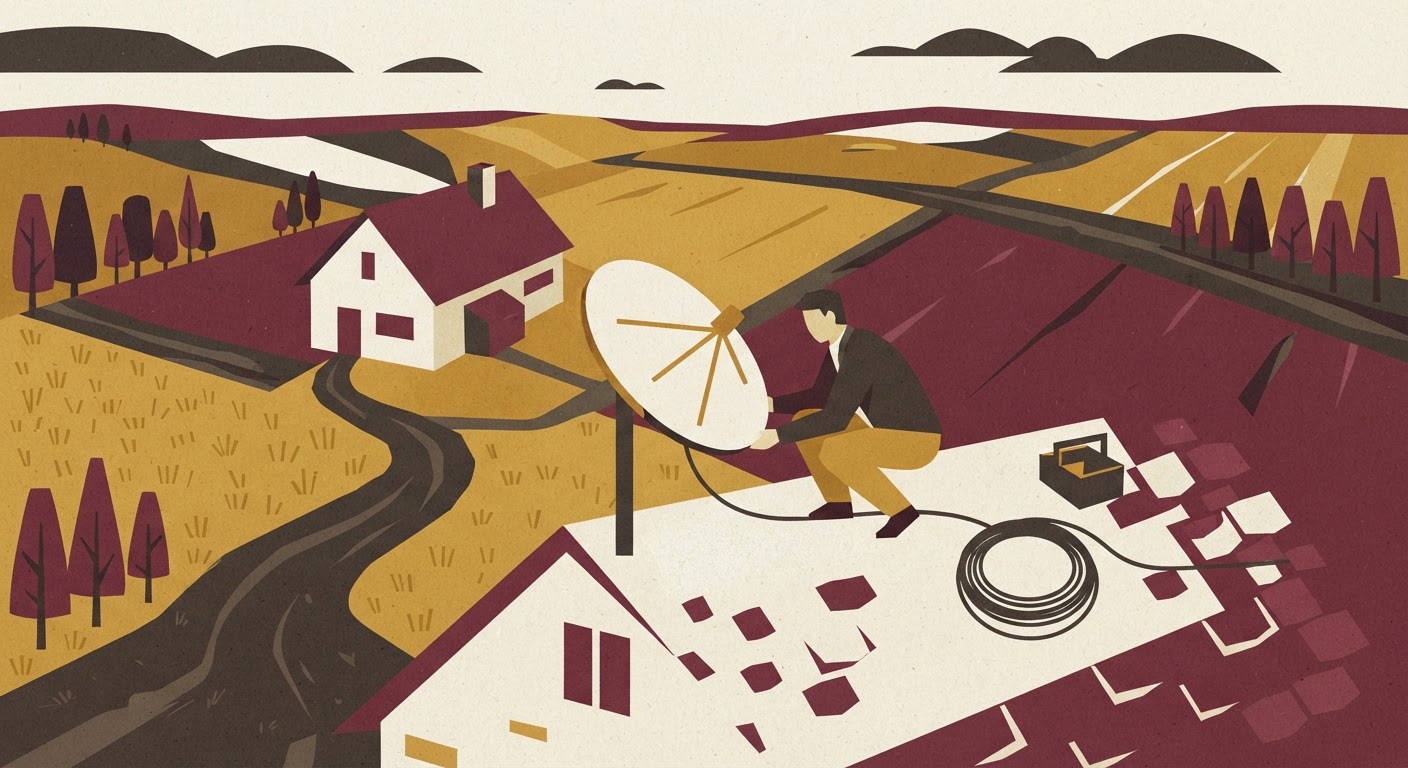
If you’ve spent an hour on hold with your county’s economic development office trying to figure out why the fiber map shows a bright green line stopping exactly at your neighbor’s driveway, you already know the answer isn’t complicated. It’s just expensive. Running cable or fiber costs a certain amount per mile, and when your road has four houses spread across three miles, the math doesn’t work for a phone company or even most electric co-ops. They’ll tell you it’s “under evaluation” for the next grant cycle, which can mean anywhere from two years to never. Co-ops that have expanded into broadband are often doing heroic work, but they’re also working through the same buildout math, prioritizing the roads with the most households per mile first. If your place sits at the end of a spur or across a creek that needs its own crossing, you may simply be low on that list for a long time.
That’s the reality that pushes a lot of rural households toward satellite or fixed wireless as the only realistic way to get a connection that can handle online banking, telehealth appointments, bill pay, and whatever your grandkids need for schoolwork. Neither option is charity. Both come with real upfront costs, and understanding those costs before you sign anything is the difference between a good decision and a contract you’re stuck with for two years.
Upfront equipment costs for satellite and fixed wireless versus monthly lease fees
Satellite internet requires a dish, a modem, and professional installation, and providers typically offer you two paths to get that gear: pay for it outright, or lease it as part of your monthly bill. Buying the equipment upfront usually costs several hundred dollars, sometimes more depending on the service tier, but it means you own it free and clear once the truck pulls out of your driveway. Leasing spreads that same cost into a monthly fee added on top of your service charge, which feels easier at the time but adds up over a year or two to more than the equipment would have cost to just buy.
Fixed wireless, where a local or regional provider beams a signal from a tower to a receiver mounted on your house or a pole, tends to have a smaller upfront equipment cost than satellite, but it depends heavily on how far you are from the nearest tower and whether they need to install anything extra to get a clean line of sight. Some fixed wireless providers waive the installation fee if you commit to a contract term, which sounds generous until you read the fine print on what happens if you cancel early.
Before you commit to either, ask the provider directly what the total cost looks like at month one, month twelve, and month twenty-four under both the buy option and the lease option. Get it in writing or at least in an email. A lot of rural households get surprised not by the sticker price of the equipment, but by add-on fees for professional installation, pole mounting, or a second technician visit when the first one couldn’t get a signal.
Comparing installment financing offered by providers to using a personal loan or credit union line
Some satellite and fixed wireless providers offer to let you pay for the equipment in installments over a set number of months, folded into your regular bill. On paper this looks similar to financing a big-ticket item, but it’s worth checking whether there’s an interest rate or markup built into that installment plan versus the cash price. Providers don’t always advertise this clearly, and the only way to know is to ask what the total installment cost adds up to compared with paying cash on day one.
If your local credit union offers a small personal loan or an unsecured line of credit, it’s worth comparing that option side by side with the provider’s plan. Credit unions serving rural counties are often used to financing equipment that doesn’t fit neat categories, whether that’s a satellite dish, a livestock trailer, or a well pump, and they may offer a rate that beats the provider’s built-in installment cost. The advantage of financing through a credit union rather than the provider is that the loan is separate from your service contract. If you decide to switch providers later or the service turns out to be unreliable, you’re not tangled up in an early termination fee tied to equipment you’re still paying off. You just have a regular loan payment, same as you would for any other purchase, and you keep the flexibility to change service without penalty.
Red flags in rent-to-own equipment contracts and early termination penalties
Read the term length before you read anything else in a rural broadband contract. A lot of satellite and fixed wireless agreements run for two years, and if you cancel before that term is up, you can owe an early termination fee that’s calculated based on however many months are left on the contract. That fee exists whether you moved, whether the service never worked right, or whether a better option finally reached your road. Ask specifically what the early termination fee is in dollars, not just “a fee may apply,” and ask whether that fee shrinks each month you stay on the contract or stays flat until the very end.
Rent-to-own or lease-to-own equipment arrangements deserve extra scrutiny. Some contracts describe the equipment as yours after a certain number of payments, but the paperwork sometimes says something different, like the equipment reverting to the provider if you cancel service before the lease term ends, even if you’ve made most of the payments. If a sales rep tells you something verbally that isn’t backed up in the written contract, don’t take their word for it. Ask them to point to the specific clause, or ask for it in writing before you sign.
Also watch for automatic renewal clauses that quietly extend your contract if you don’t cancel within a specific window, and installation guarantees that promise a certain speed but only in fine print that qualifies it as “up to” that speed under ideal conditions, which your tree line, your weather, or your distance from the tower may never actually deliver.
How Lifeline and other subsidy programs can offset the true monthly cost
Depending on your household income, Lifeline is a federal program that can reduce your monthly bill for broadband or phone service, and it’s available through participating providers in a lot of rural areas, including some satellite and fixed wireless companies. It’s not going to cover the whole cost, and you’ll need to apply and show that you qualify, but it can take a real bite out of a monthly bill that otherwise feels like it’s competing with your propane budget every winter. Some state programs and rural utility offices have their own supplemental discounts on top of Lifeline, so it’s worth a call to your state’s utility consumer division or your county extension office to ask what else might apply to your situation. These programs come and go with funding cycles, so what was true last year might have changed, and it’s worth checking current eligibility rather than assuming.
Building the true cost of connectivity into your household budget before you sign
Before you sign anything, write down every number in one place: the equipment cost or installment payment, the monthly service fee, any installation or activation fee, the early termination penalty if you need to walk away, and whatever a subsidy program might knock off the top. Put that total next to your other fixed monthly costs, the same way you’d budget for a feed bill or a heating oil delivery, so you’re seeing the real number rather than just the promotional rate a rep quoted you over the phone. A connection that lets you do your banking, pay your bills, and check on your accounts without driving forty minutes to town is worth paying for. It’s just worth paying for with your eyes open, and with a contract that leaves you room to change your mind if a better option finally reaches your road.
