
If you’ve priced out a home build lately, you know the down payment isn’t the only wall standing between you and a mortgage. It’s the whole stack: down payment, closing costs, and a debt-to-income ratio that doesn’t leave much room for error when your income comes from a calving season or a harvest instead of a biweekly paycheck. USDA’s Section 523 Mutual Self-Help Housing program was built for exactly that problem, and it’s one of the few federal housing programs that treats your labor as capital instead of asking you to already have some.
What Section 523 Mutual Self-Help Housing actually is
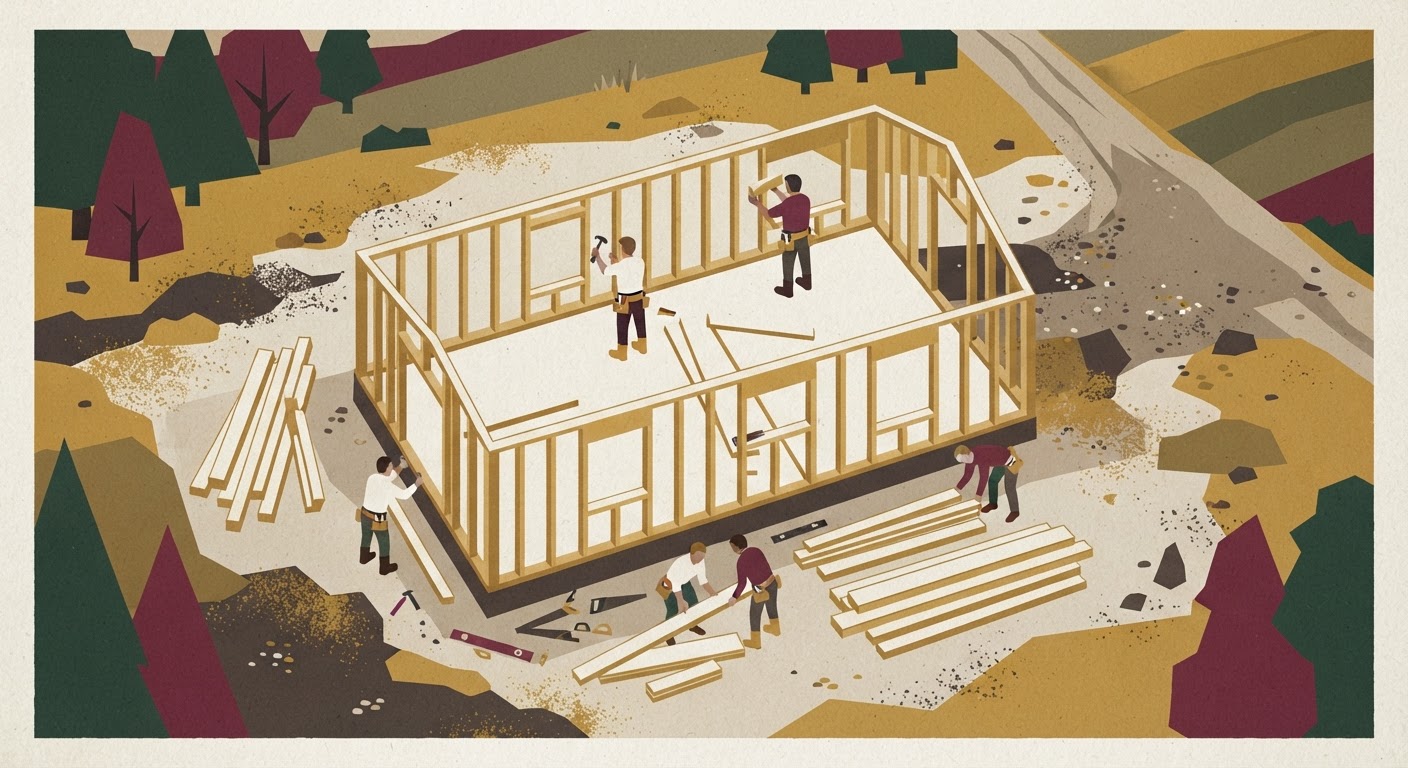
Section 523 isn’t a loan you apply for directly. It’s a grant program that funds local nonprofits and housing agencies, called “grantees,” who organize groups of eight to a dozen or so low-income families and build all their homes together, at the same time, on adjacent or nearby lots. Everybody works on everybody’s house. Nobody moves in until the group is close to finished, and then families typically move in within weeks of each other.
This is different from a standard Section 502 Direct loan, which is USDA’s core rural mortgage program for low- and very-low-income borrowers. A 502 Direct loan can finance a home you buy, build with a contractor, or rehab, and it stands alone. Self-Help housing is layered on top of that financing structure. Most self-help participants still take out a 502 Direct loan to cover materials, land, and contracted work like plumbing and electrical hookups. The self-help piece is what shrinks how much you need to borrow, because your labor gets credited against the cost of the house instead of you paying a contractor’s full labor bill.
How sweat equity replaces the down payment
Here’s the mechanic that matters most: USDA appraises what the finished home would cost with hired labor, then subtracts the value of the labor your family and your group contribute. That difference is your sweat equity, and it functions like a down payment did in a conventional deal. Since 502 Direct loans generally don’t require a cash down payment for eligible low-income borrowers anyway, what self-help really does is lower your total loan amount and your monthly payment for the life of the mortgage, not just at closing.
Say a home would cost a certain amount to build entirely with hired trades. If your group’s combined labor covers a meaningful chunk of that, usually somewhere in the range of a quarter to nearly half of construction value depending on the build and local labor rates, you’re financing a smaller number for thirty years. That’s the whole trade: you put in hours now so you owe less later. It’s not free money, but it’s the closest thing to it that a federal housing program offers, because the “payment” is calluses and weekends, not cash you don’t have.
Finding a group build near you
Section 523 doesn’t run everywhere, and it’s not something USDA operates directly at the county level. It runs through regional and local nonprofit grantees, often the same organizations that handle 502 Direct loan packaging or rural housing counseling. Your starting point should be your state’s USDA Rural Development office, which keeps a list of active self-help grantees in the state. Some grantees cover a single county, others cover a whole multi-county region and rotate group builds through different towns over several years.
Because these builds depend on having enough interested, eligible families in one area at one time, timing matters. A grantee might not have an active group forming in your county this year but could next year. It’s worth getting on a waiting list or an interest list even before you’re fully sure you want in, since the application and eligibility screening takes time regardless.
The time commitment, honestly
Most self-help programs expect somewhere around 30 to 40 hours a week of labor from each participating adult household member, though some grantees run evening-and-weekend schedules for families who can’t leave day jobs. A typical group build runs anywhere from eight months to over a year, depending on group size, weather, and how many houses are going up at once. Farmers and ranchers should talk to the grantee directly about scheduling around planting and calving, because falling behind isn’t just an individual problem in this program, it’s a group problem.
If a family falls seriously behind on their labor hours, the group as a whole can fall behind, since everyone works on every house and the crew moves roughly in tandem. Grantees generally have a process for addressing chronic no-shows, from a warning and revised plan up to removal from the group in cases that don’t improve. Life happens, and a decent grantee will work with a family through a rough patch, but this isn’t a program where you can coast while your neighbors carry your house.
Skills required (and what you’ll actually learn on-site)
You do not need construction experience to join. That’s the point. A construction supervisor employed by the grantee is on-site to teach and direct the work, and the tasks are broken down so that framing, siding, insulation, drywall, painting, and site cleanup are all things a first-timer can learn hands-on. Specialized trade work like electrical and plumbing hookups is usually still done or supervised by licensed contractors, since that’s often required by code and by USDA regardless of self-help status.
What you bring is reliability, a willingness to take direction, and physical stamina. What you leave with, besides a house, is a working knowledge of how your own home was put together, which matters later when something needs fixing and you’re not paying a service call to find out where the shutoff valve is.
Combining self-help credit with your 502 Direct loan
The financing usually works like this: you apply for and get approved for a 502 Direct loan based on your income and the appraised cost of the home. The grantee coordinates with USDA on the labor-credit calculation, and that credit reduces the loan amount you close on. You’re still responsible for standard 502 Direct underwriting, including income limits tied to your county’s area median income and your ability to repay, so self-help doesn’t bypass eligibility, it just changes the math once you’re in the door.
When a neighbor drops out mid-build
Groups are sized with some cushion, but a mid-build dropout still creates real strain, since remaining families may need to cover more hours to keep the schedule on track. Grantees typically try to backfill with another eligible family if the build is early enough, or redistribute hours among the remaining group if it’s late-stage. It’s a fair question to ask a grantee upfront: what’s your track record with groups losing a member, and what’s the plan when it happens.
The trade-off, plainly
Self-help housing is slower than closing on a house next month. You’re looking at close to a year of hard weekend and evening labor, sometimes more, before you get keys. What you get in return is a meaningfully smaller mortgage and a home you understand from the studs out. For a lot of rural families without cash sitting around for a down payment, that’s not a bad trade. It’s just not a fast one.
