
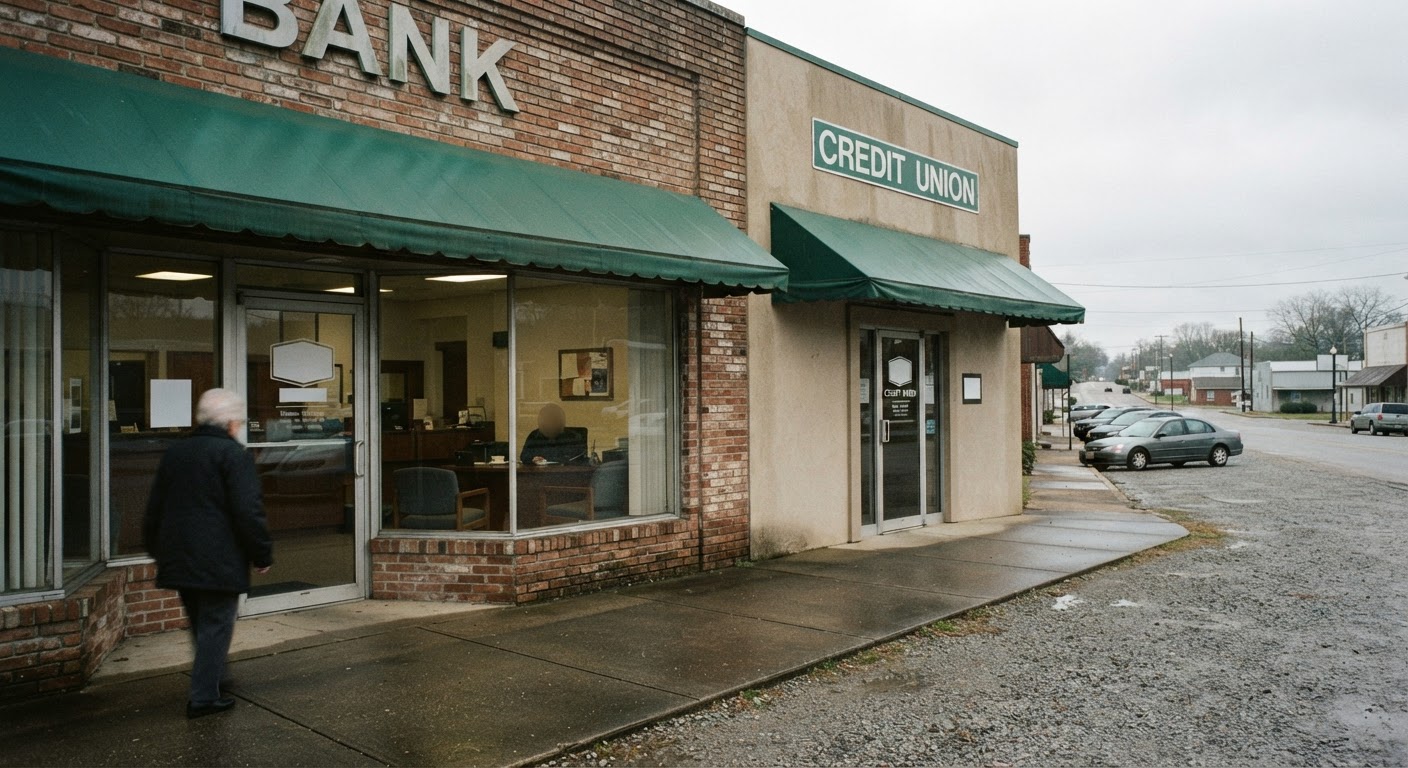
Who Owns the Place, and Why That Changes How Your Loan Gets Decided
Walk into a community bank and, legally speaking, you’re a customer of a for-profit business owned by shareholders. Those shareholders might be local families who’ve held stock for three generations, or they might be a holding company two states away that bought the bank in a merger. Walk into a credit union and you’re a member-owner. Every checking account, every auto loan, every share certificate makes you a partial owner of the institution, and in theory, you get a vote in how it’s run.
That distinction sounds like paperwork trivia until you’re the one asking for a loan on a piece of equipment the underwriting manual doesn’t quite know how to categorize.
Community banks answer to shareholders who want a return. That doesn’t make them heartless — plenty of small-town bank presidents have personally driven out to look at a hay crop before approving an operating loan — but the bank’s loan committee is ultimately weighing risk against profit, and if the parent company has tightened its risk appetite this year, your local branch manager may have less discretion than the guy behind the counter suggests.
Credit unions answer to members. There’s no outside shareholder demanding a specific margin, which is part of why credit unions have historically been able to offer lower loan rates and higher savings rates — the “profit” gets returned to members rather than paid out as dividends to investors. The tradeoff is that credit unions are often smaller, with a narrower field of membership (you may need to live, work, or worship in a specific county, or belong to a particular co-op or association to join), and their capital base for large or unusual loans can be thinner.
Neither structure guarantees a better outcome for you individually. A well-capitalized community bank with a loan officer who’s known your family for twenty years can outperform a credit union that’s never financed a combine. The ownership structure tells you the institution’s incentives, not the specific person across the desk. Ask who actually makes the final call on a loan of your size — a local officer, a regional committee, or an automated underwriting system — before you assume ownership structure settles the question.
Fees and Minimums: Read the Schedule, Not the Brochure
Both credit unions and community banks in small towns tend to be gentler on fees than the big national banks, but “gentler than a mega-bank” is a low bar, and there’s real variation between the two.
- Monthly maintenance fees: Credit unions more often waive these entirely for basic accounts, or waive them with a modest average balance or a direct deposit. Community banks are more likely to charge a monthly fee unless you keep a higher minimum balance or bundle multiple accounts.
- Minimum balance requirements: Community banks, especially ones that have merged with regional chains, sometimes carry over tiered account structures with balance minimums scaled for suburban customers, which can feel steep if your income arrives seasonally, like a farm settlement check twice a year rather than a biweekly paycheck.
- Overdraft and NSF fees: Both types of institutions charge these, but credit unions are statistically more likely to offer a grace period, a courtesy pay program with a lower cap, or a simple linked-savings transfer option instead of a flat penalty.
- ATM access: This is where geography bites hardest. Credit unions frequently belong to shared branching networks and surcharge-free ATM alliances, which can mean fee-free access at machines and even teller windows hundreds of miles away — genuinely useful if you winter somewhere else or your kids are at college three counties over. Community banks vary a lot here; some participate in regional fee-free networks, others don’t.
- Out-of-network fees: If the nearest branch of either institution is forty minutes away and you’re relying on a machine at the gas station, both will likely charge you, plus whatever the machine’s owner tacks on. Ask specifically about the shared network before you open an account, not after your card gets declined at the only ATM in town.
The honest way to compare fees isn’t to trust the brochure — it’s to ask for the actual fee schedule document, which every federally insured institution is required to provide, and hold the two side by side. Look specifically at what triggers a fee, not just the fee amount, since a $0 monthly fee that requires a balance you can’t maintain in a slow month isn’t actually free.
Agricultural and Small-Business Lending: Different Comfort Zones
This is where the two institution types diverge most sharply, and it matters more to rural customers than almost any other factor on this list.
Community banks, particularly ones that have been in a farming county for decades, often have deep institutional memory around agricultural lending. They understand seasonal cash flow, they know what a given crop or herd is realistically worth in a bad year versus a good one, and many participate in government-backed agricultural loan guarantee programs that reduce the bank’s risk on operating loans, equipment loans, and farm real estate. If your credit needs are tied to planting and harvest cycles, a bank with a dedicated ag lending desk and an officer who’s underwritten dozens of similar operations can move faster and structure terms more realistically than an institution encountering your situation for the first time.
Credit unions have expanded into agricultural and small-business lending, but capacity varies enormously by institution. Some rural credit unions have built genuine ag lending expertise and can be very competitive, particularly for members who’ve built a savings and deposit history with them over years. Others simply don’t have the balance sheet size or specialized staff to comfortably hold a large farm real estate loan, and will refer you elsewhere or participate only as a minority partner alongside another lender.
For small-business lending outside of agriculture — a shop, a trade business, a small retail operation — the pattern is similar. Ask directly: how many loans like mine has this institution made in the last year, and can I talk to the loan officer who actually handles this category, not just a generalist. Also ask whether the institution sells its loans on the secondary market or keeps them in its own portfolio. Portfolio lenders (common among both community banks and credit unions) often have more flexibility to structure a loan around your actual cash flow rather than a rigid national underwriting formula, because they’re the ones who live with the risk.
Questions to Ask Before You Switch
Before you move your accounts or your loan relationship from one to the other, sit down with a real person and ask:
- Who makes the final decision on a loan my size — you, a regional committee, or an automated system?
- Do you keep loans like mine in your own portfolio, or sell them?
- What’s your actual experience with agricultural or small-business loans in this county, and can I talk to someone who handles those directly?
- What’s the complete fee schedule, including ATM and out-of-network charges, and what specifically waives each fee?
- If your branch closes or reduces hours, what’s my access to cash, deposits, and a human being — shared branching, mail deposit, mobile deposit limits?
- What happens to my loan or account if the institution merges or is acquired? (This is a real risk for both types, but especially for smaller community banks that get bought by regional chains.)
There’s no universal right answer between a credit union and a community bank — it depends on what you need financed, how you’re paid, and how far you’re willing to drive. The point of asking these questions isn’t to find the “correct” institution type. It’s to find out, in practical terms, whether the specific place you’re considering actually understands how people in your county make and spend money — because that understanding, more than the sign on the building, is what determines whether you get treated fairly when you actually need help.
