
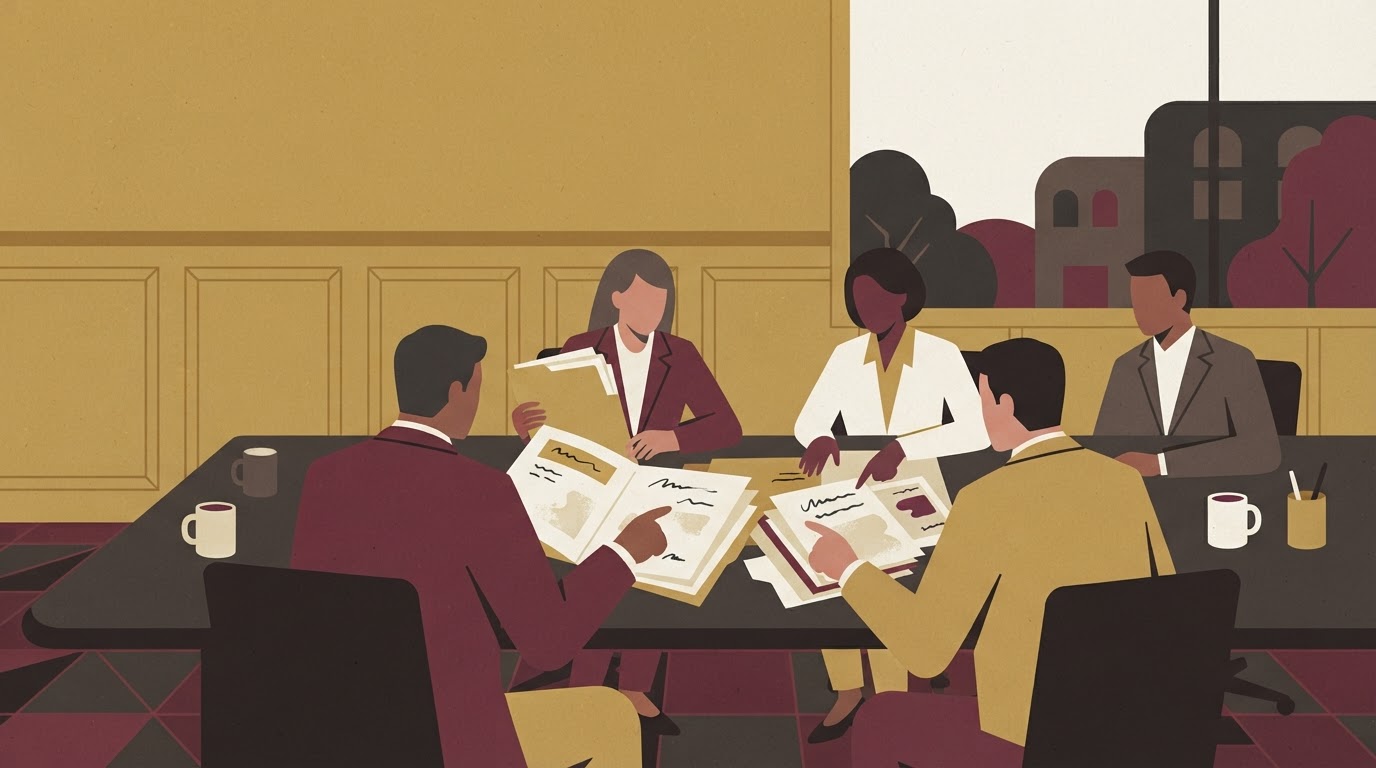
The mechanics of a small-town loan committee meeting versus automated underwriting
If you’ve applied for a loan at a big national bank, you probably never talked to a human being who had any real say in the outcome. Your application went into a system, that system pulled your credit score, your debt-to-income ratio, and a handful of other standardized inputs, and a decision came back in minutes or days. Nobody in that process had ever driven past your place or knew your name from church, the co-op, or the volunteer fire department.
A lot of community banks still do it differently. Your application gets pulled together by a loan officer, then it goes in front of a loan committee — often a handful of people who meet weekly or biweekly, sitting around a table with a stack of files. These committees usually include senior bank officers, and at smaller institutions, they may include board members who are also local farmers, business owners, or retired professionals. They’re not running your numbers through a black box. They’re reading a summary, asking the loan officer questions, and sometimes just talking about you as a person they’ve heard of or dealt with before.
This matters because the committee has room to weigh things a credit score can’t capture, and room to bring in opinions that have nothing to do with your finances. Both of those things are true at once, and understanding that is the key to working with this system instead of getting surprised by it.
What local knowledge can factor in that a credit score never will
A national underwriting algorithm doesn’t know that the 200 acres you’re using as collateral butts up against land that just sold for a strong price, or that your hay ground has never gone dry in a drought year because of how it drains. It doesn’t know that your income looks thin on paper in January because you’re a cattle producer and most of your money comes in in the fall. It doesn’t know that your equipment, even though it’s fifteen years old, is kept in a shed and maintained like new because everyone in the county knows you as somebody who takes care of things.
A local loan officer or a committee member who’s from the area can factor in seasonal cash flow patterns that make sense for farming, ranching, or trades work but look erratic to a formula built for salaried borrowers. They can factor in land values based on recent local sales rather than a generic appraisal model that may not reflect what ground is actually worth in your county. They can factor in reputation — whether you’ve paid back what you owed to the implement dealer, whether you show up when you say you will, whether your operation has weathered a bad year before without falling apart.
None of this shows up on a credit report. It’s the whole argument for relationship banking, and in a lot of rural counties it’s still the difference between getting financed and getting a form letter.
How to present your application to a committee, not just a computer
If your loan is going in front of people instead of a program, treat the application differently. A computer doesn’t care about context. A committee does.
Write out a short narrative for your loan officer to bring to the meeting — not just the numbers, but the story behind them. If your income was down last year because of a drought, a late spring, or an injury that kept you out of the field for two months, say so plainly and explain what’s different this year. If you’re asking for financing on equipment, explain how it fits into the operation and what it replaces or adds. Committees respond to a clear, honest explanation a lot better than they respond to a bare balance sheet.
Bring supporting documents that speak to local reality: recent land sale comparisons if you’re using ground as collateral, production records if you’re in agriculture, contracts or letters of intent if you’re a tradesperson with steady work lined up. Ask your loan officer, ahead of time, what the committee tends to focus on and whether there’s anything in your file that’s likely to raise a question. A good loan officer wants you to walk in prepared, because they’re the one presenting your case in the room when you’re not there.
When relationship banking helps you and when it can work against you
Relationship banking cuts both ways, and it’s worth being honest about that instead of pretending small-town banking is always warmer and fairer than the big-city version.
It helps you when the people making the decision actually know your track record and can vouch for context a formula would miss. It helps you when there’s a long-term relationship at stake — a bank that’s financed three generations of your family has an interest in seeing the fourth generation succeed, not just in this quarter’s numbers.
It can work against you when small-town politics get mixed into business decisions. Old disputes, family history, local reputation that has nothing to do with your creditworthiness, or simply who you’re related to can color a committee’s view in ways that would never happen with an anonymous algorithm. Limited competition compounds this. In a county with one or two banks, you may not have the option to just walk down the street to someone who doesn’t know the backstory. If a committee decides it doesn’t like you, or likes a competitor of yours better, there may not be an easy alternative nearby.
Neither the algorithm nor the committee is inherently more fair. They just fail in different directions — one fails by ignoring your real situation, the other can fail by letting your real situation, or somebody’s opinion of it, carry too much weight.
Questions to ask a loan officer about how decisions actually get made at that institution
Before you commit your business to one bank, it’s fair to ask direct questions about their process. Ask whether loan decisions are made locally or sent to a regional or out-of-state office for final approval — some “community banks” are locally branded but owned by larger holding companies, and the real decision-making committee may not be in your county at all. Ask how often the loan committee meets and roughly how long you should expect to wait for an answer. Ask whether the committee includes people who know the local land market, local agriculture, or local trades, since that’s the whole value of going local in the first place. Ask what kind of documentation helps your case the most at that particular institution — every bank’s committee has its own habits and preferences. And ask, plainly, whether there’s an appeal process if you disagree with a decision, because not every bank has one, and it’s better to know that before you need it.
What to do if you feel a decision was based on something other than your financials
If you walk away from a denial suspecting the reason had more to do with who you are, who you’re related to, or some local grudge than with your actual finances, start by asking the loan officer for a specific, written explanation of the decision. You’re entitled to know the stated reason for a credit denial, and getting it in writing gives you something concrete to respond to rather than a vague impression.
From there, consider asking to speak directly with a senior lender or bank president about your application, especially if you have a long history with the institution. Small banks often have more flexibility to revisit a decision than their formal process suggests, particularly if you can address the stated concern directly. If you believe the decision involved unlawful discrimination rather than ordinary local politics, that’s a matter for the appropriate regulatory or legal channels, not something to sort out informally over the counter.
And if none of that resolves it, remember that relationship banking is a two-way relationship. You’re also allowed to take your file, your deposits, and your future business to a different institution — even if that means driving a little farther down the highway.
