
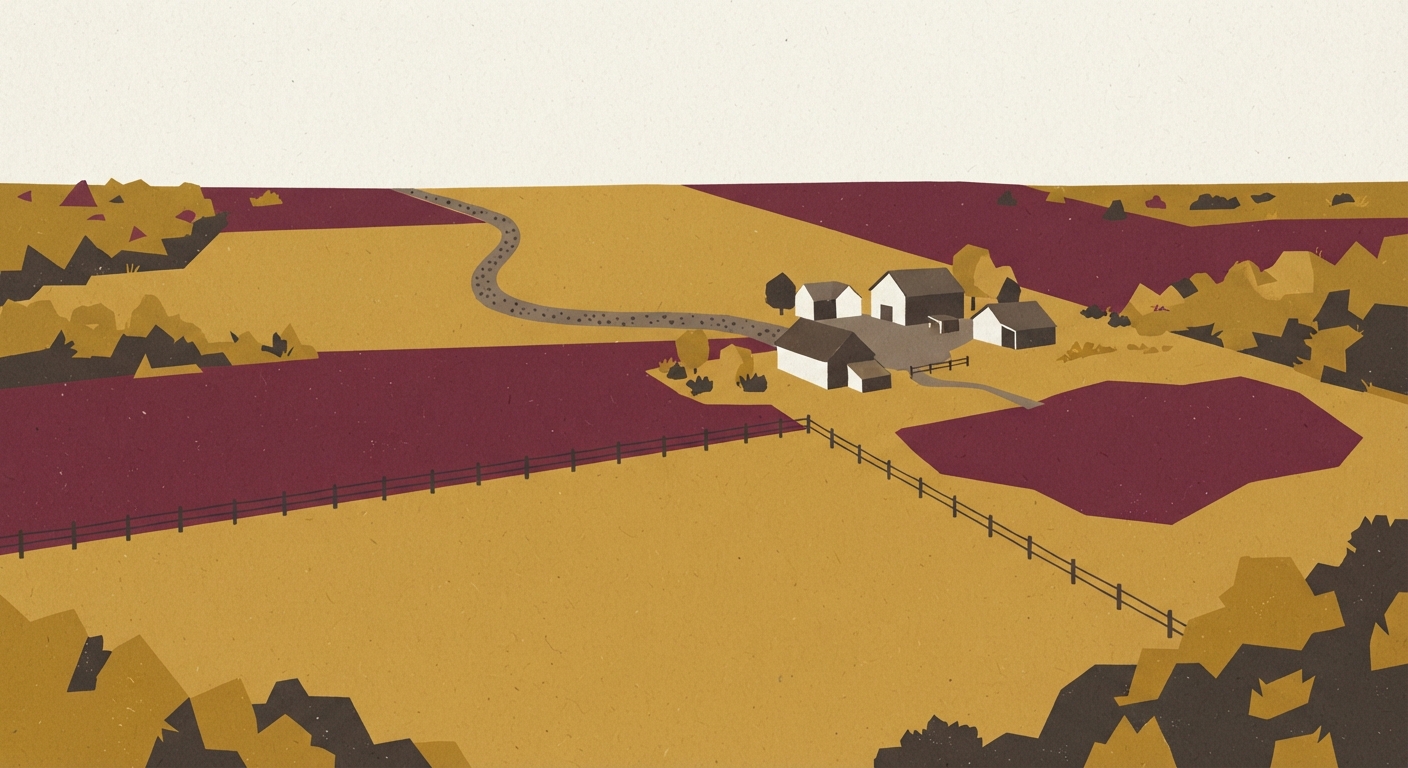
Most people who own a few acres, a pond, and a couple of outbuildings don’t think of themselves as running a “premises” the way a strip mall or an apartment complex does. But that’s exactly how a court will look at your place if someone gets hurt on it. A suburban quarter-acre lot with a fence around the yard and a locked gate presents one kind of risk. Eighty acres with a stock pond, a network of ATV trails, a barn full of interesting equipment, and a herd that occasionally finds its way onto the county road presents a completely different one — and most standard homeowners or farm liability limits were priced and written for the first scenario, not the second.
Why open land and loose livestock create exposure standard policies weren’t built for
A typical homeowners policy carries liability limits in the low hundreds of thousands. A basic farm policy might add a bit more, tied mainly to farm operations. Those numbers were set with a fairly contained risk picture in mind: a house, a yard, a driveway, maybe a dog. They weren’t built around the reality of rural land, which tends to invite people onto it whether you want them there or not.
Think about what’s actually on your property. A pond that freezes over in winter and looks like a perfect place to skate. A network of trails that neighbor kids or hunters wander onto without asking. Cattle or horses that get out through a gate someone forgot to latch and end up on the highway, causing a wreck. A four-wheeler that a visiting nephew borrows without quite knowing how to handle it. Any one of these can turn into a lawsuit with damages that blow past a standard policy’s limit in a hurry, especially if there’s a serious injury or a death involved. Once the judgment exceeds your coverage, the rest comes out of your land, your equipment, your savings, and potentially your future income.
How umbrella and excess liability coverage stacks on top of what you already have
An umbrella or excess liability policy doesn’t replace your homeowners, farm, or auto coverage — it sits on top of it. Once the liability limit on your underlying policy is used up, the umbrella takes over and keeps paying, up to its own limit, which is often far higher than anything available through the base policies alone.
There’s a practical requirement most carriers attach to this: they want you to carry a certain minimum liability limit on the underlying policies before they’ll write the umbrella on top. That’s because the umbrella is priced assuming the first layer of risk is already handled by something else. If your farm policy’s liability limit is too thin, you may need to raise it before an umbrella carrier will even quote you. This is worth asking about specifically, because it’s a common surprise — people assume they can just buy a big umbrella and skip strengthening the base policy, and that’s usually not how it works.
Umbrella policies also tend to cover some situations that base policies exclude or cap tightly, like certain libel or slander claims, or liability that follows you off your own property. For a rural landowner, the bigger draw is usually the sheer size of the cushion it provides against the kind of claim that a pond, a trail, or a stray bull can generate.
What counts as an “attractive nuisance” and why it matters for lawsuits
Courts have long recognized a concept called “attractive nuisance” — features on your land that are appealing, especially to kids, but also dangerous. Ponds, old equipment, barns, tree stands, and abandoned wells are classic examples. The legal significance is that landowners can be held to a higher standard of care for these features than for ordinary risks, even when the person who got hurt wasn’t invited onto the property and was technically trespassing.
This matters because a lot of rural landowners assume that “no trespassing” signs or the fact that someone wasn’t invited will shield them from liability. It often won’t, especially when children are involved. If a neighbor’s kid wanders onto your land and falls through pond ice, or gets hurt climbing on old farm equipment, the fact that they weren’t supposed to be there doesn’t automatically get you off the hook. The law in many places asks whether you took reasonable steps to prevent foreseeable harm from a hazard you knew was appealing and dangerous. That’s a case-by-case legal question, and it’s exactly the kind of exposure umbrella coverage exists to catch.
Typical coverage amounts and premiums for rural landowners versus suburban policyholders
Rural umbrella policies generally start at coverage levels similar to suburban ones, but landowners with significant acreage, water features, livestock, or recreational access often end up buying more than the entry-level amount once an agent walks them through the actual exposure. The premium difference between a suburban umbrella policy and a rural one with similar coverage limits isn’t usually dramatic on its own, but rural policyholders often pay somewhat more per dollar of coverage because the underlying risk factors — livestock, water, unfenced access, ATVs and other recreational vehicles — are weighed into the pricing.
What drives the price more than almost anything else is what’s actually happening on the land. A property with a pond, horses, and a trail system that neighbors use will cost more to insure than one with none of those things, even if the acreage is similar. Farmers and ranchers who lease land for hunting, host farm-stay guests, or run any kind of agritourism operation should expect extra scrutiny and likely a higher premium, because those activities bring more people onto the property with less control over who they are and what they do while they’re there.
Questions to ask a local agent about bundling coverage
Because umbrella policies depend so heavily on the underlying homeowners, farm, and auto policies underneath them, this is one area where a local independent agent who knows rural risk is worth more than a call center. A few questions worth bringing to that conversation:
Ask what minimum liability limits your homeowners, farm, and auto policies need to carry before an umbrella carrier will write a policy on top, and whether raising those limits changes your base premiums much. Ask whether your farm equipment, livestock operations, and any recreational vehicles are all disclosed and covered consistently across policies, since gaps between how your auto policy treats an ATV and how your farm policy treats it can leave holes an umbrella won’t fill. Ask specifically whether hosting hunters, guests, or agritourism visitors requires an endorsement or a separate policy, since general umbrella coverage may not anticipate paying customers on the land. And ask how claims involving trespassers, particularly minors, are handled under both the base policy and the umbrella, since this is often the exact scenario landowners are trying to protect against.
Steps to take now that lower both risk and premium
Insurance is only half the answer. Reducing the odds that someone gets hurt in the first place helps your premium and, more importantly, helps you avoid the whole situation.
Fence off ponds and other standing water where you reasonably can, and post clear signage at trailheads, gates, and water features warning of hazards. Keep fences and gates in good repair, especially along roads and property lines where livestock could get out, and document your maintenance schedule in case you ever need to show you were keeping up with it. Lock up or disable ATVs and other recreational vehicles when you’re not around to supervise their use, and keep ladders, tree stands, and old equipment secured rather than left out where kids might climb on them. If you allow hunting, riding, or other recreational access, consider a signed waiver as an added layer, even though it won’t guarantee protection on its own.
None of these steps eliminate the risk of a lawsuit, but insurers notice them, neighbors notice them, and courts weighing whether you took “reasonable care” notice them too. Combined with the right umbrella limit, they’re the most realistic way to protect land you’ve likely spent a lifetime building, from a single bad afternoon you never saw coming.
