
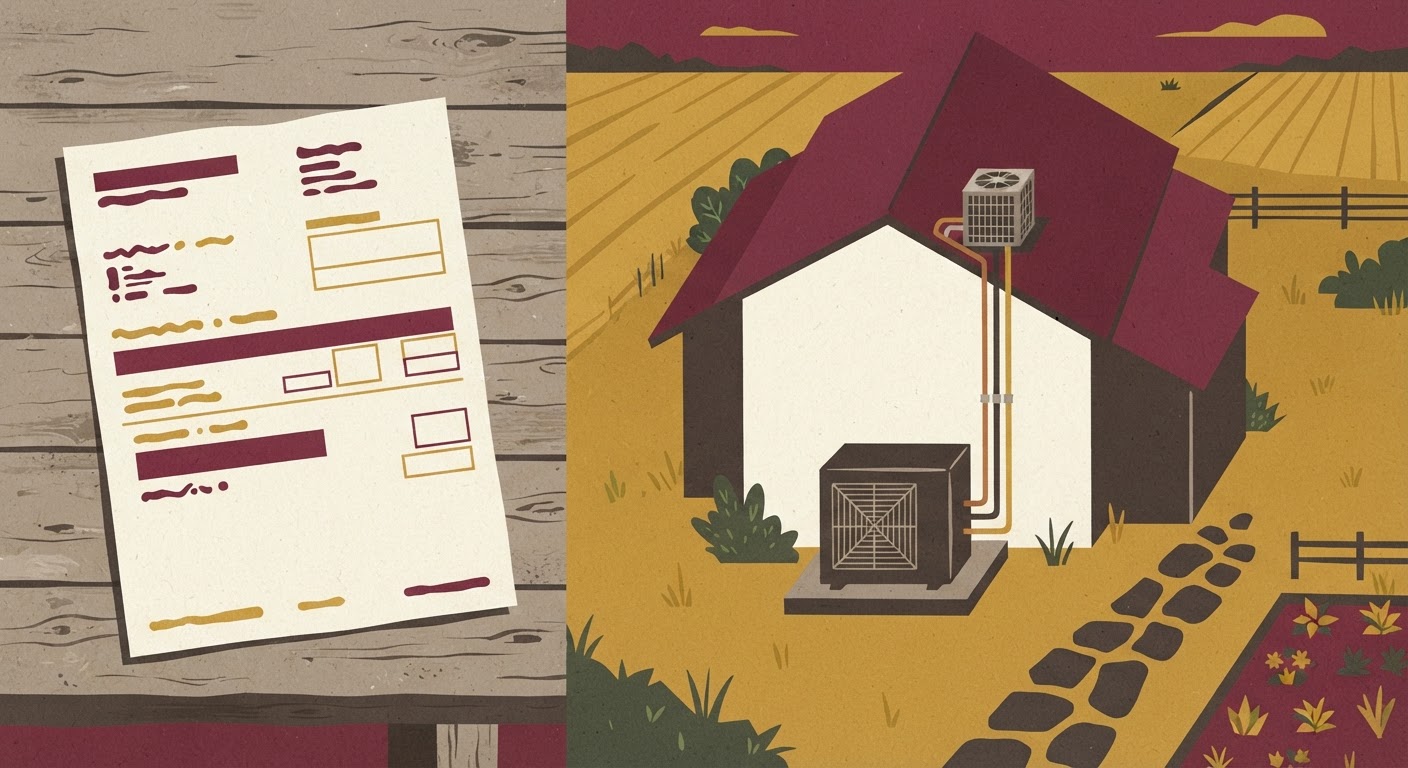
If your propane bill made you wince last winter, or your wiring is old enough that your insurance agent has started asking pointed questions, you’ve probably priced out the fix and then closed the browser tab in frustration. A new heat pump, a proper insulation job, or a panel upgrade can run several thousand dollars, and the nearest bank branch might be forty-five minutes away and not especially interested in a loan that size anyway. This is where a growing number of rural electric cooperatives have quietly stepped in, offering members a way to pay for exactly these kinds of upgrades through their power bill instead of through a bank at all.
What on-bill financing actually is
On-bill financing is pretty much what it sounds like. Your electric co-op pays the upfront cost of an approved home improvement, usually something that makes your house more efficient or safer, and then you pay that money back in fixed installments added to your monthly electric statement. There’s no separate loan payment to track, no second due date to remember, and no new line item competing with your mortgage or truck payment. It just shows up as an extra charge on the bill you’re already paying.
The co-op recovers its cost over time, often with a modest interest charge built in, and the arrangement stays attached to the electric meter at that address rather than to you personally as a borrower. Some co-ops run these programs themselves using their own capital, while others partner with a regional financing organization or a state energy office to fund the upfront cost and just handle the billing and collection locally. Either way, the co-op is the one you deal with, and the co-op is the one who cuts off contact if something goes wrong, not a call center in another state.
What these programs typically cover
Most on-bill programs are built around one main goal: lowering the amount of electricity or fuel a home uses, because that makes the math work for everyone involved. The upgrades that show up most often include heat pumps and heat pump water heaters, attic and wall insulation, air sealing, duct repair, and electrical panel or wiring upgrades that let a home safely handle modern heating and cooling equipment.
Some co-ops extend this further into things that aren’t strictly about energy use but still matter a lot in rural areas, like replacing a failing well pump or upgrading wiring that’s become a fire hazard. A few even help cover the cost of a home energy audit up front, so you know which upgrade will actually save you the most before you commit to anything. Coverage varies a lot from one co-op to the next, so what your neighbor’s co-op offers three counties over may not match what yours does. The common thread is that the project has to be something the co-op’s engineers or a certified contractor can sign off on as legitimate and correctly installed, not just any home repair you’d like help paying for.
How approval is different from walking into a bank
This is the part that surprises a lot of members the first time they hear about it. Many on-bill programs don’t run a credit check at all. Instead of underwriting you the way a bank would, based on your credit score, income documentation, and debt-to-income ratio, the co-op underwrites the meter and the account history. If you’ve been a member in good standing, paying your electric bill on time for a reasonable stretch, that payment history often carries more weight than a FICO score ever would.
This matters a great deal for people who’ve been turned down or discouraged from applying for financing elsewhere. Retirees on fixed income, tradespeople with irregular cash flow depending on the season, and farmers whose income is lumpy because it follows harvest or calving rather than a biweekly paycheck all tend to look worse on paper to a conventional lender than they actually are in practice. A co-op that’s watched you pay your bill reliably for years already has a pretty good read on your reliability, no credit bureau required.
How the rates and terms stack up
Interest rates on on-bill programs tend to run lower than what you’d get on an unsecured personal loan from a bank or credit union, partly because the co-op isn’t taking on the same risk profile and partly because many of these programs are subsidized in some way to encourage energy efficiency. Terms are often set up to roughly match the expected savings on your bill, so the idea is that the extra charge for repayment is offset, at least partially, by what you’re no longer spending on inefficient heating or a failing water heater.
Compared to a USDA home repair loan or grant program, which can offer excellent terms but usually comes with more paperwork, income limits, and a longer approval timeline, on-bill financing tends to move faster and with less documentation. It won’t always be the cheapest option in absolute dollar terms if you qualify for one of the USDA programs, but for a lot of members it’s the option that actually gets used because it doesn’t require a trip to a regional office or weeks of waiting on paperwork. It’s worth comparing both if you have the patience, since USDA repair assistance can sometimes be layered with a co-op’s own program depending on the project.
What happens if you sell or move
Because the financing is tied to the meter or the account rather than to you as an individual, what happens at sale time depends heavily on how your specific co-op structured the agreement. Some programs are designed so the remaining balance transfers to the next occupant of the home, essentially becoming a charge that runs with the property, similar to how certain assessments attach to real estate. Others require the balance to be paid off in full at the time of sale or when the account closes, which means it functions more like a personal obligation that follows you, not the walls.
This distinction matters enormously if you’re weighing whether to take on the financing at all, especially if you think you might sell within the next several years. Don’t assume either way. Ask directly, in writing, what happens to the unpaid balance if the home changes hands or if you move off the co-op’s lines entirely, and get that answer before you sign anything, not after.
How to find out if your co-op offers this
Start with a phone call to your electric cooperative’s member services line and ask specifically whether they offer on-bill or “pay as you save” style financing for efficiency upgrades. Not every co-op advertises this prominently on their website, and some staff who don’t work in that department may not think to mention it unless you ask by name. If your co-op does have a program, ask what projects qualify, whether there’s a credit check involved, what the interest rate and term length are, whether an energy audit is required first, and exactly what happens to the balance if you sell or leave. Also ask whether they work with a list of approved local contractors, since some programs require installation by a vetted installer to guarantee the work.
If your co-op doesn’t currently offer anything like this, it doesn’t hurt to ask whether they’ve considered it or know of a regional program through your state’s rural electric association. These programs have been spreading county by county, and cooperative boards do pay attention when members ask for something specific.
