
The basic split: yield/revenue protection vs. physical property coverage
Here’s the confusion that trips up a lot of farmers, especially ones who are new to running their own operation or who inherited land and the insurance decisions that come with it: crop insurance and farm property insurance sound like they should overlap, but they’re built to answer completely different questions. Crop insurance asks, “Did you get the harvest and revenue you were expecting?” Farm property insurance asks, “Did something happen to the physical stuff you own?” Those are not the same question, and a policy built to answer one will not stretch to cover the other, no matter how bad your year was.
Crop insurance, in almost all cases, is tied to the federal system run through the USDA’s Risk Management Agency. It pays out based on shortfalls in yield or revenue compared to your established guarantee. It doesn’t care why your bin collapsed or your combine caught fire. It cares whether the bushels came in low or the price tanked or both.
Farm property insurance is the more familiar kind of coverage, closer to homeowners insurance but built for farm risk. It covers physical loss or damage to buildings, structures, and often equipment, from named perils like fire, wind, hail, lightning, and theft. It doesn’t care what your yield was. A bin full of nothing but air still costs the same to rebuild as a bin that was packed with corn.
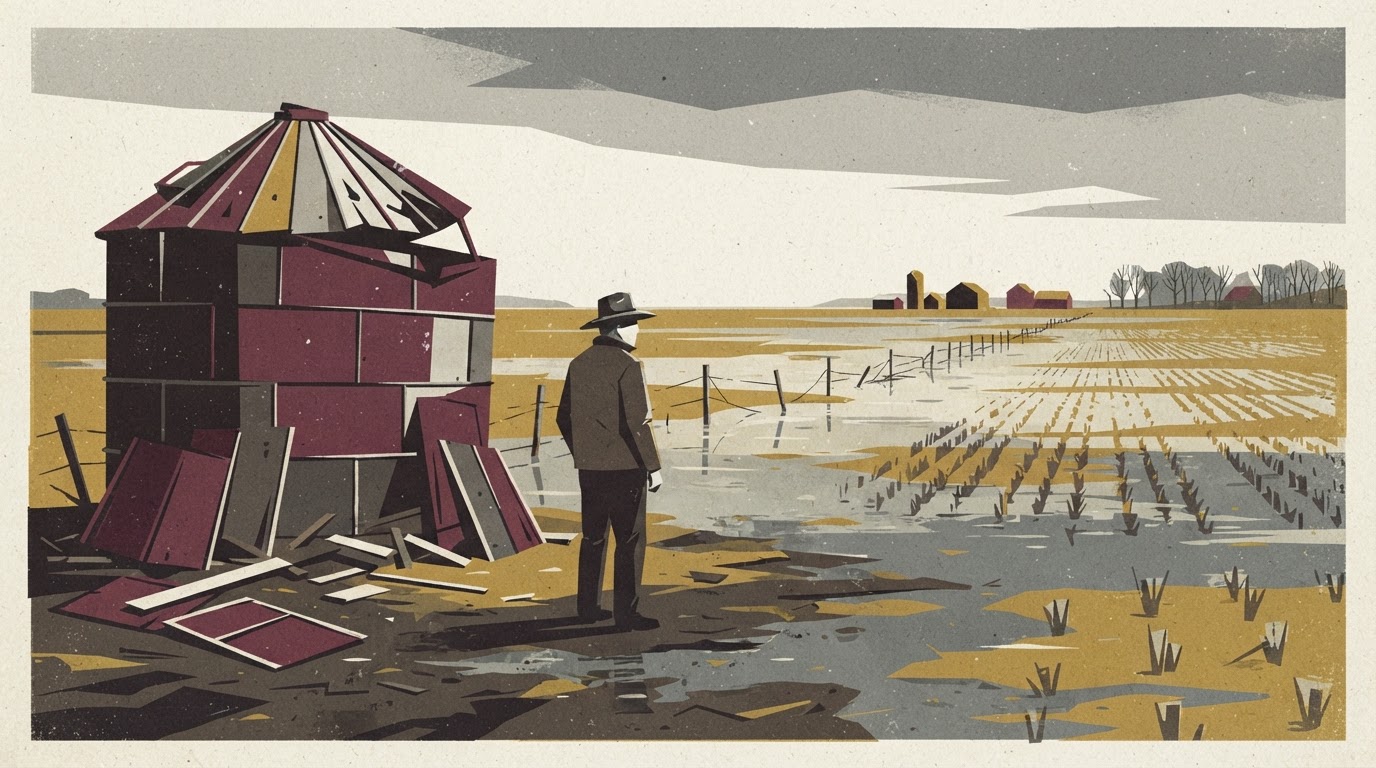
Once you see the split this way, a lot of the confusing edge cases start making sense. The storm that flattens your crop and takes the roof off your machine shed in the same afternoon is really two separate insurance events, running through two separate systems, even though it felt like one bad hour to you.
How USDA’s Risk Management Agency programs work, in brief
Federal crop insurance works off a guarantee you establish based on your own production history, or an area-based guarantee if you don’t have enough history yet. You pick a coverage level, and if your actual yield or revenue falls short of that guaranteed level because of an insurable cause, like drought, excess moisture, hail, or disease, the program pays the difference.
The private companies that sell and service these policies are working within rules set by RMA, which is why the paperwork and deadlines feel so rigid compared to a regular insurance transaction. Sales closing dates, acreage reporting deadlines, and notice-of-loss timeframes aren’t suggestions. Miss one and you can lose coverage for that crop year even if the loss itself was completely legitimate.
The important thing to keep in mind is that this system is measuring output, not equipment. It doesn’t ask what your grain cart is worth or whether your fence held up in the wind. It asks how many bushels you got per acre, or how much revenue you generated, compared to what you were supposed to get. That’s the whole ballgame.
What a standard farm property policy covers that crop insurance never will
A farm property policy is where your buildings, grain bins, shops, barns, and often scheduled equipment live, insurance-wise. If lightning takes out your hog barn, if a wind event peels the roof off your machine shed, if someone breaks into your shop and walks off with tools and a welder, this is the policy that responds, not your crop insurance.
Most farm property policies also cover things that don’t fit neatly into “buildings,” like grain in storage under certain conditions, farm vehicles not licensed for the road, and sometimes livestock, depending on how the policy is written. This is also usually where liability coverage lives, which matters if a hired hand gets hurt or a visitor has an accident on your property.
The key distinction to hold onto: farm property insurance is about replacing or repairing physical things you already own. It has nothing to do with what you were going to harvest or sell. A bin that never had a single bushel in it this year is still worth its full replacement cost if it gets crushed by a windstorm.
Real gaps: drainage tile, fencing, and equipment left in the field
This is where a lot of farmers get an unpleasant surprise, usually right after a loss instead of before one. Drainage tile is a common gap. It’s expensive to fix when it collapses or gets crushed, and depending on how your property policy is written, buried tile may be excluded or have limited coverage unless you’ve specifically addressed it with your agent. Crop insurance obviously won’t touch it either, since tile isn’t a crop or a yield number.
Fencing is another one, especially for ranchers. A lot of standard farm policies treat fencing differently than buildings, sometimes with lower coverage limits or separate deductibles, and a long stretch of fence knocked down by a fallen tree or a flood can cost more to replace than people expect.
Equipment sitting in the field is its own category of risk. A combine or sprayer parked at the edge of a field when a hailstorm or fire comes through may or may not be treated the same as equipment sitting in the shed, depending on your policy’s terms about location and use. This is exactly the kind of detail that gets settled by a phone call to your agent before planting season, not during a claims dispute after the fact.
How to coordinate claims when a single storm damages both crop and buildings
When one storm hits both your standing crop and your buildings, you’re actually filing two claims with two different processes running on two different clocks, and treating them as one combined event is where people lose time and sometimes money.
Start by documenting everything separately. Photograph crop damage in the field before you do any cleanup or replanting, since RMA-approved adjusters will want to see the extent of loss before conditions change. Separately, photograph and inventory building and equipment damage the way you would for any property claim, with attention to what’s structural, what’s contents, and what’s a total loss versus repairable.
Notify your crop insurance agent and your property insurance carrier as close to the same time as possible, but understand they’re not talking to each other unless you make the connection yourself. Crop adjusters work off RMA timelines and procedures. Property adjusters work off your policy’s specific claims process. If you wait to report one because you’re dealing with the other, you risk running past a deadline on the one you set aside.
Keep a single loss file with dates, phone calls, adjuster names, and claim numbers for both. It sounds like overkill until you’re three weeks into recovery and can’t remember which adjuster said what about which building.
Working with an agent who understands both systems instead of just one
In a lot of rural areas, crop insurance and farm property insurance get sold by different agents, sometimes at different agencies altogether, and that split can leave real gaps in your overall coverage that nobody catches until there’s a loss. An agent who only sells crop insurance may not flag that your machine shed is underinsured. An agent who only sells property insurance may not know your prevented planting options if a wet spring keeps you out of the field entirely.
It’s worth asking directly whether your agent, or agency, handles both lines and reviews them together, not just separately once a year at renewal. If they don’t, it’s reasonable to ask your crop insurance agent and your property agent to at least be aware of each other, so you’re not the only one holding the full picture of what’s covered and what isn’t.
The goal isn’t finding one policy that does everything. That policy doesn’t exist, and any agent who tells you it does is either confused or overselling. The goal is making sure the two systems you’re relying on actually add up to full coverage when you look at them side by side, instead of leaving a gap right in the middle where your buildings and your bushels were supposed to meet.
