
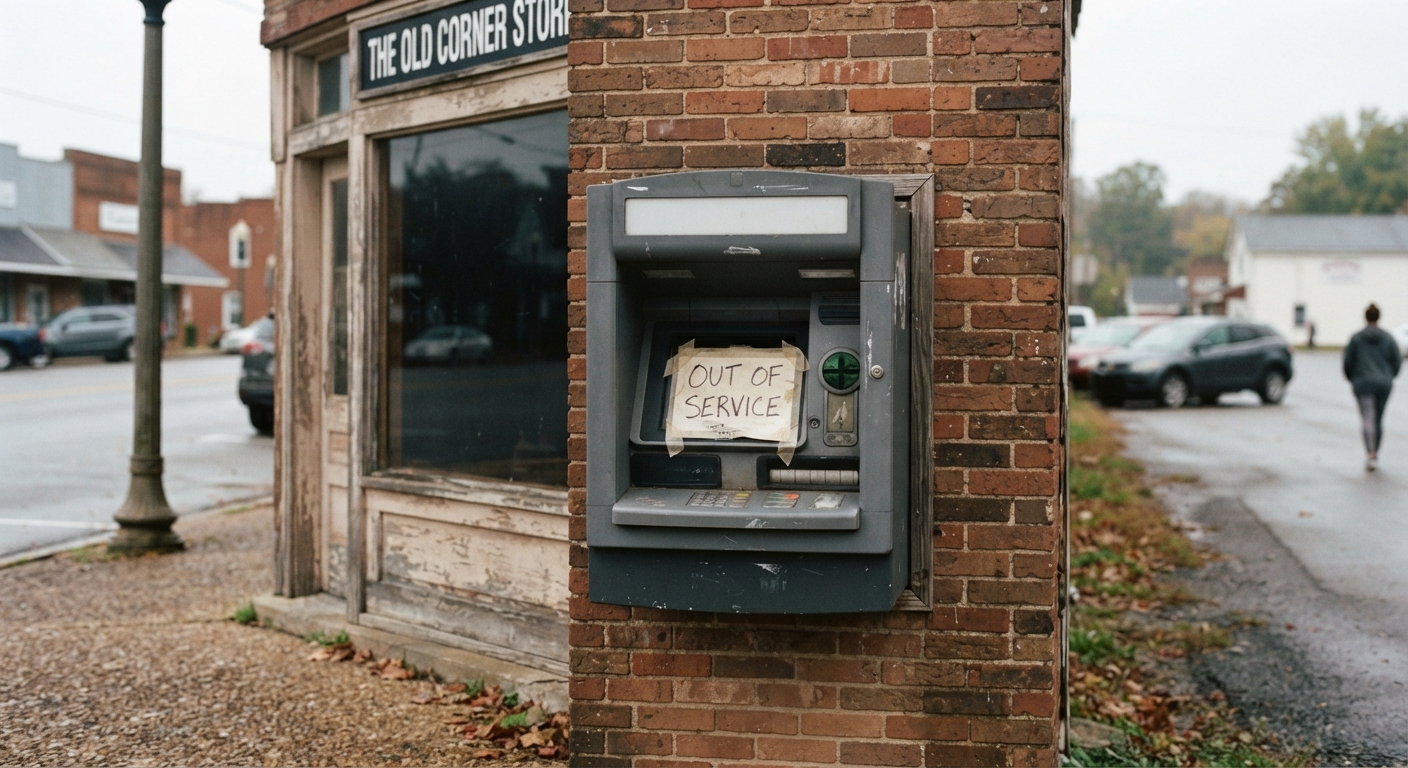
Why One Machine Ends Up Carrying an Entire Town
If you live in a small town, there’s a good chance the ATM you rely on isn’t run by a bank at all. It’s more likely owned by an independent ATM operator who leases space at the gas station, the feed store, or the convenience mart on the highway. These are sometimes called “white-label” machines, and they exist because it’s not profitable for a regional bank to keep a branch — or even a standalone bank-owned ATM — in a town with a small population and thin deposit base. The math doesn’t work for them. But it can work for a third-party operator who charges a surcharge every time someone withdraws cash, spreads that machine across a route with dozens of others, and doesn’t carry the overhead of tellers, security guards, or a lobby.
That arrangement is why so many rural communities have exactly one reliable cash point, and why that machine is often not affiliated with anyone residents can walk into and talk to. When something goes wrong, you’re not calling a local branch manager. You’re calling a number on a sticker, if there’s a number at all, that connects to a call center that may not even know your town exists until someone flags it.
How Often Rural ATMs Actually Go Down, and Why Refills Lag
Every ATM eventually jams, runs low on paper, or simply runs out of cash. In a city, that’s a non-event — there are three other machines within walking distance. In a small town, it’s the only game in town, and the fix isn’t quick.
Most ATMs are refilled by armored car services that run set routes on set days, often once or twice a week, because sending an armored truck out to a town of a few hundred people isn’t cheap and the volume doesn’t justify daily visits. If a machine runs dry on a Thursday and the truck isn’t scheduled until Tuesday, that’s five days without cash access, not five minutes. Add distance — many of these routes cover multiple counties — and a mechanical issue like a jammed cassette or a receipt paper outage, which a technician has to physically drive out to fix, and you’re looking at a repair window measured in days.
Weather makes it worse. A snowstorm, a flooded county road, or a wildfire evacuation route closure can delay both armored car refills and repair technicians at the exact moment residents most need cash — for generators, for supplies, for gas at a station that may lose power and go card-only-when-the-power’s-out, which of course means it can’t process cards either. The machines that serve rural areas are, ironically, the ones most exposed to the conditions that knock them offline.
The Ripple Effect on Local Businesses
When the town’s only ATM goes down, it’s not just an inconvenience for the person who needed forty dollars for the weekend. It hits the businesses that depend on that machine to keep cash moving through the local economy.
Think about the diner that does its biggest business on Saturday morning when ranch hands and retirees come in for breakfast, many of them paying cash because that’s how they’ve always budgeted and because card fees eat into a small operator’s margin. Think about the farmers market, the church rummage sale, the volunteer fire department’s pancake breakfast fundraiser — all cash-dependent events that cluster on weekends, which is exactly when a broken ATM is least likely to get fast attention, since service calls often lag over Saturday and Sunday. A dead machine on a Friday afternoon can mean a visibly quieter Saturday for every cash-reliant business in town, not because people didn’t want to spend money, but because they physically couldn’t get to it.
Business owners in these towns often notice the ATM’s health before anyone else does, simply because they watch their own register fill with the same twenties over and over, or watch customers walk in, pat their pockets, and walk back out.
Backup Cash Strategies Worth Having in Place
You can’t fix a fragile ATM network by yourself, but you can build habits that make you less dependent on any single machine on any single day.
Cash-back at checkout is the most underused tool in small towns. Most grocery and convenience stores that run debit transactions can add cash back at no cost or a small flat fee, often cheaper than an out-of-network ATM surcharge. If your town has a grocery store, hardware store, or pharmacy that runs debit, ask whether they offer cash back and make it part of your regular routine rather than an emergency fallback.
Some towns have informally organized around this already — a loose understanding where the gas station, the feed store, and the diner all know each other well enough that a regular customer can get change or a small cash-back favor in a pinch. These arrangements aren’t formal financial services, and they shouldn’t be treated as guaranteed, but they reflect how small-town economies have always filled in the gaps that formal banking leaves open. If your town doesn’t have this kind of loose network, it’s worth a conversation with a few local shop owners about how they’d want to handle it if the ATM goes dark for a week.
Keeping a small cash float at home — enough to cover a few days of essentials — is old advice, but it’s old advice for a reason. It’s not about hoarding; it’s about not being caught flat when the one machine you rely on has a paper jam and the technician is two counties away.
How to Report Outages and What to Ask Before You Rely on a Machine
Most ATMs display a phone number for reporting problems, usually the operator’s customer service line rather than the store’s. Call it every time the machine is down, even if you assume someone else already has — operators often route service based on ticket volume, so a machine with three complaints gets attention faster than one with none.
It also helps to loop in the store or gas station hosting the machine. They have a business relationship with the operator and more leverage to push for faster refills or repairs than an individual customer does. If outages are frequent, ask the store owner whether they’ve raised it directly with the operator, and whether the town has any collective way to flag patterns rather than one-off complaints.
Before you build your routine around any single machine, it’s worth asking a few questions: How often does this ATM actually run out, based on what regulars have noticed? Who refills it, and how often? Is there a second cash option — a bank branch, a credit union, a grocery store with cash back — within a reasonable drive, even if it’s inconvenient? Knowing the answers before you need them is a lot better than finding out during a shortage.
Signs a Town Is at Risk of Losing Its Last ATM
ATM operators pull machines that aren’t profitable, and there are usually warning signs before that happens. Longer stretches between refills, a machine that’s “temporarily out of service” more often than not, a host business that mentions the operator is asking about transaction volume — these are all signals that a town’s last machine may be on borrowed time.
Residents aren’t powerless here. Local business associations, county commissions, and even informal resident groups have leverage they don’t always realize they have. Documenting outages, gathering signatures or letters from regular users, and formally raising the issue with the operator or with the store hosting the machine can matter — operators respond to visible transaction volume and organized complaints more than scattered frustration. Some towns have also had luck approaching a local credit union about installing a branded machine, since credit unions are sometimes more willing to serve thin-margin communities than large banks are. Whatever the path, the first step is treating the ATM not as a fixture that will always be there, but as a service that has to be actively maintained by the people who depend on it.
