
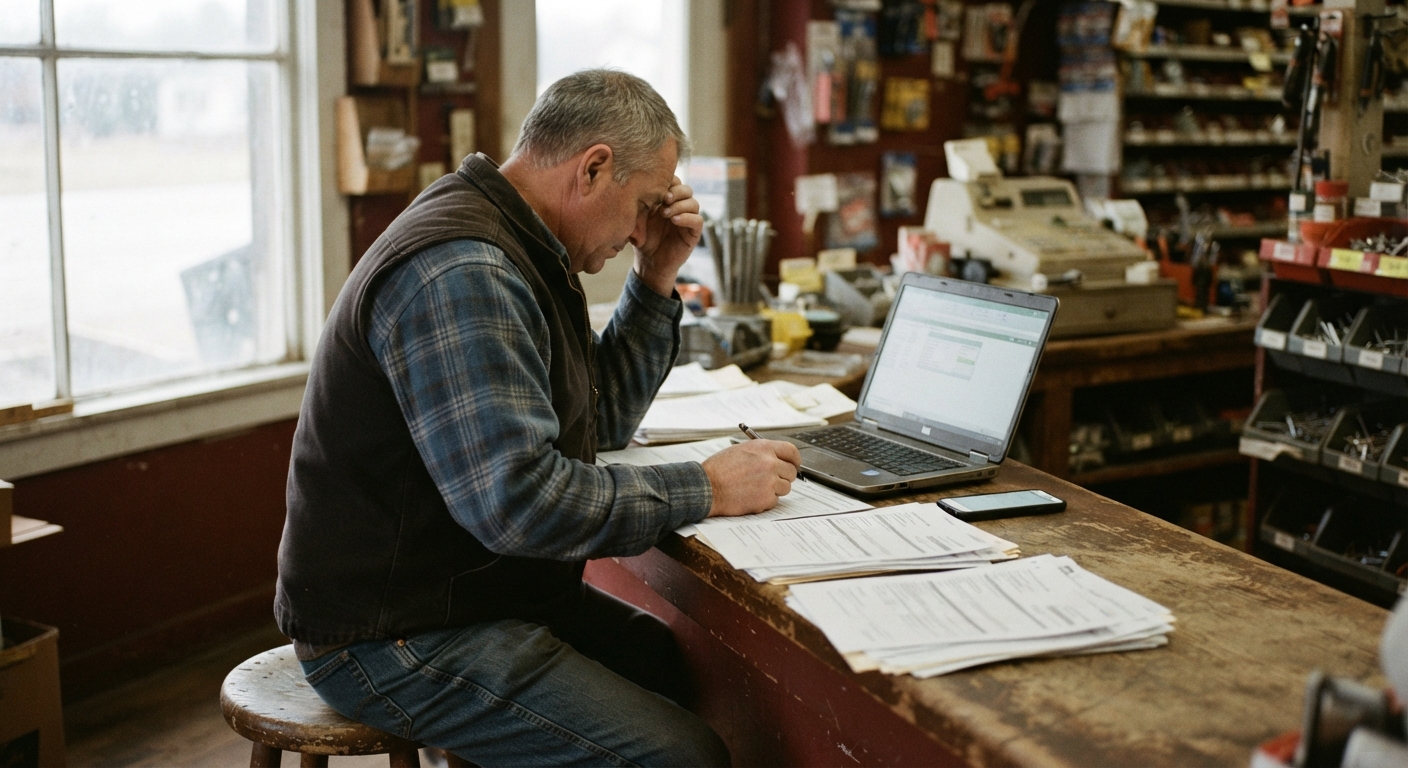
The working capital gap: why seasonal cash flow gaps hit harder out here
If you run a feed store, a small excavation outfit, or a diner off the highway, you already know the rhythm: money comes in waves, and the gaps between waves can get long. A hardware store stocks up for spring planting season months before farmers start spending. A contractor buys materials before the check from the job clears. A rancher-adjacent business waits on livestock sale timing that doesn’t care what the electric bill schedule looks like. In a city, a business owner in a cash crunch can walk into three or four bank branches in an afternoon and talk to a real person about a short-term fix. Out here, the nearest business banker might be an hour’s drive, and that banker may not know your operation, your land, or your customers from a stranger’s application.
That distance matters more than it should. Relationship banking has always leaned on a loan officer who’s seen your books for years and knows that your slow winter isn’t a red flag, it’s just how the business works. When that relationship thins out or disappears because a branch closed or consolidated, rural business owners are left applying for credit the same way anyone in a big city does, except without the backup plan of just walking somewhere else. Understanding your options before the cash crunch hits is the best defense you have.
Revolving lines of credit vs. term loans: which fits your business
A line of credit works like a financial safety net that resets. You get approved for a maximum amount, you draw on it when you need cash, and you pay interest only on what you’ve actually used. That structure fits businesses with inventory swings or seasonal billing gaps particularly well. A farm supply store that needs to stock up before spring and doesn’t get paid back until crops sell can draw down a line in February and pay it back in July, then let it sit unused the rest of the year.
A term loan is different. You borrow a fixed amount, get it in one lump sum, and pay it back on a set schedule regardless of whether business is booming or slow that month. That structure fits a one-time purchase better than an ongoing cash flow problem — think a new delivery truck, a walk-in cooler, or a building repair. It doesn’t flex with your slow season, so if your revenue is genuinely lumpy throughout the year, a term loan payment due in a dead month can create more stress than it solves.
Plenty of rural businesses end up needing both eventually: a term loan for the equipment that keeps the doors open, and a line of credit for the weeks when the equipment is paid off but the customers haven’t shown up yet. Knowing which tool solves which problem keeps you from taking on the wrong kind of debt for the wrong kind of gap.
How SBA 7(a) and microloan programs work through remote-friendly lenders
The Small Business Administration doesn’t lend money directly in most cases. It guarantees a portion of a loan that a bank or an approved lender makes, which lowers the lender’s risk and makes them more willing to say yes to a business that doesn’t fit a standard risk model. The 7(a) program is the SBA’s main workhorse loan, used for working capital, equipment, and even buying out a business partner. It can be a genuinely good fit for a rural operation with an uneven revenue history, because the guarantee gives the lender room to look past a rough year that a strict metro underwriting model might reject outright.
Microloan programs, run through nonprofit community development financial institutions, serve a smaller but often more accessible need — usually a lower amount than a full SBA 7(a) loan, aimed at newer or smaller operations that don’t have years of financial statements to show. What makes both of these programs workable from a distance is that a growing number of community development lenders have built their entire process around phone calls, mailed documents, and video meetings, precisely because their mission is reaching underserved areas. They’re not going to shrug you off for not having a branch nearby — reaching people without a nearby branch is the point of their existence.
The tradeoff is that these applications take real paperwork and real patience. They’re not instant, and they’re not designed to be. But the terms are usually far more favorable than what you’ll find from a lender that promises same-day cash.
What documentation substitutes for an in-person relationship
When a loan officer can’t look you in the eye across a desk and vouch for you personally, the paperwork has to do that work instead. That means being ready with more than the bare minimum. Tax returns for the business and personally, for at least the last two years, are close to non-negotiable. Bank statements showing consistent deposits, even seasonal ones, help a lender see the pattern rather than just a snapshot. A simple written business plan — even a few pages — that explains your seasonal cycle clearly can do a lot of the relationship-building that an in-person meeting used to handle. If your revenue dips every winter and spikes every spring, say so directly and show the pattern over multiple years so it reads as normal, not alarming.
Collateral documentation matters too, especially for equipment, land, or vehicles you’re willing to put up against the loan. Photos, appraisals, and titles help a remote underwriter picture what they can’t drive out and see themselves. And don’t underestimate a simple, direct cover letter explaining who you are and what the business does — it sounds old-fashioned, but it’s often the only human context a distant underwriter gets.
Using a local accountant, extension office, or SBDC advisor as your on-the-ground advocate
You don’t have to do this alone, and you shouldn’t. Small Business Development Centers, often connected to a state university system, offer free or low-cost help preparing loan applications, and their advisors deal with rural and small-town businesses regularly — they know which lenders actually work with operations like yours. Your county extension office, more associated with agriculture, often has staff who understand farm-adjacent business cycles and can point you toward ag-friendly lending programs you might not find on your own.
A local accountant who already knows your books can also serve as a translator between your business and a lender who’s never met you. They can package your financials in a way that reads clearly to an underwriter three states away, flag issues before a lender does, and sometimes make a phone call on your behalf that carries more weight coming from a credentialed third party than from you alone. None of these advocates replace the old relationship banker, but together they can rebuild some of what that relationship used to provide.
Red flags in online-only lenders marketing to underserved areas
Rural business owners are a known target for lenders who advertise fast approval and minimal paperwork, and some of those pitches are worth real scrutiny. Be cautious of any lender who won’t clearly state the interest rate as an annual percentage rate, and instead talks only in terms of a flat fee or a daily payment amount. Daily or weekly automatic withdrawals from your business account can quietly drain cash flow in ways a monthly payment never would, especially during a slow stretch.
Watch for pressure to sign quickly, vague language about “factor rates” instead of interest rates, and any lender who seems more interested in your bank account access than your business plan. A legitimate lender, whether it’s a bank, an SBA-approved lender, or a community development fund, will want to understand your business and will be transparent about total repayment cost. If a lender’s entire pitch is about speed and nothing about understanding your operation, that’s worth a second look before you sign anything.
