
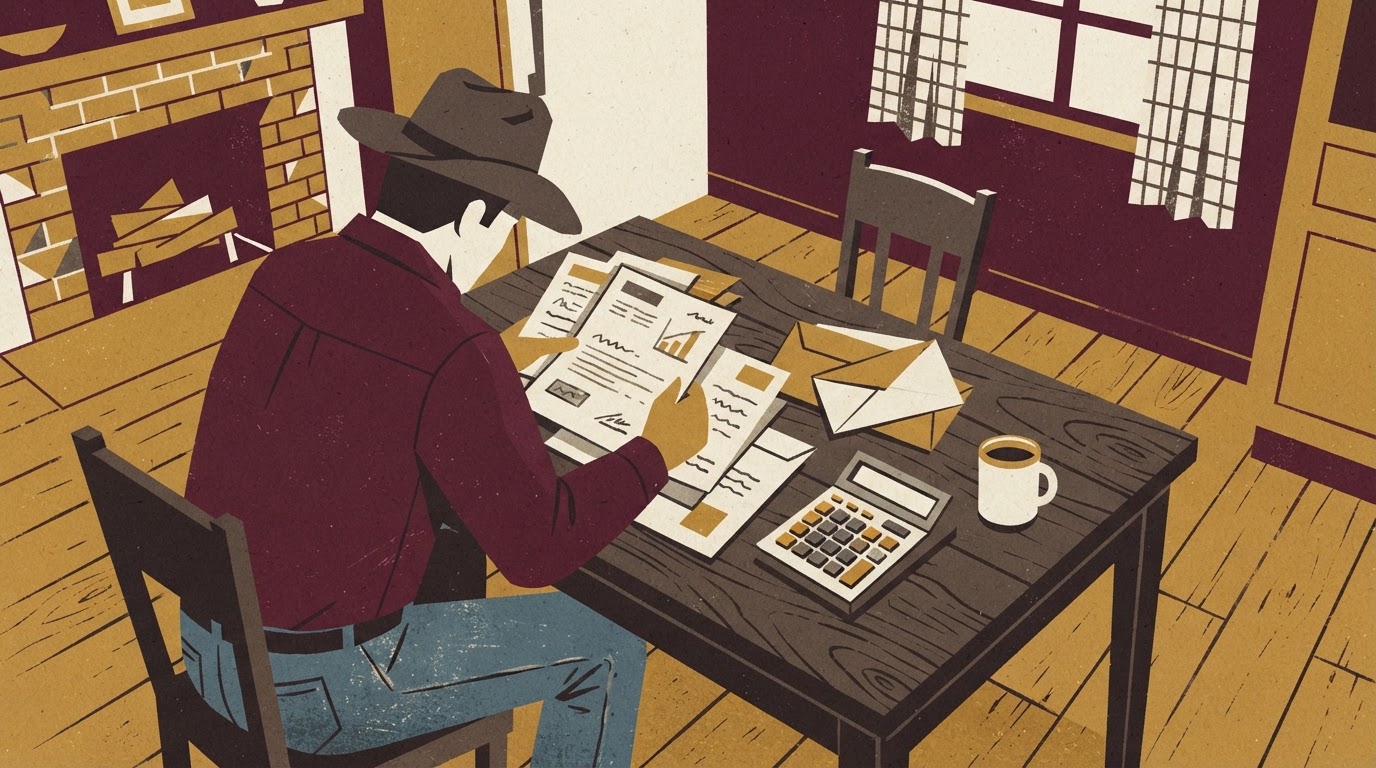
If you’ve ever sat across from a loan officer trying to explain that yes, you made most of your money in October and November and basically none in February, you know the look. It’s not hostility. It’s confusion. Most consumer lending software was built around a simple assumption: you get a paycheck every two weeks, it’s roughly the same amount each time, and your employer will confirm it with a phone call. That model works fine for a lot of people. It does not work for someone who sells calves in the fall, gets a wheat check at harvest, does most of their welding and fencing work between April and October, or draws Social Security plus a modest CD ladder that pays out on its own schedule.
Mortgage underwriters have actually gotten decent at this. They’ve had decades of practice with farm income, and there are established ways to average two or three years of tax returns to arrive at a qualifying number. Personal loan officers and credit card underwriters haven’t had that same education. Their systems ask for “monthly income” as a single field, and if what you type in doesn’t match a pattern their algorithm recognizes, you get an automatic decline or a request for more paperwork than a mortgage application asks for. Understanding why this happens is the first step to working around it, because once you know the system is looking for monthly consistency, you can present your seasonal income in a way that gives it something to hold onto.
How to document irregular income for a personal loan or credit line application
The paperwork that proves seasonal income isn’t fundamentally different from what a salaried person provides — it’s just older and thicker. Where a W-2 employee hands over a couple of recent pay stubs, you’re going to lean on a longer paper trail: prior-year tax returns, settlement sheets from grain elevators or livestock auctions, invoices from contract work, and any 1099s you’ve received. The goal is to show a lender not just what you made, but that what you made repeats in some recognizable pattern year over year.
When you fill out the income field on an application, don’t just guess at a monthly figure. Take your total annual income from a reliable source — usually the prior year’s return — and divide it by twelve yourself, then be ready to explain in the notes or in a conversation with the lender that the income arrives in two or three lump sums rather than spread evenly. Some online applications have a field for “additional information” or a place to upload documents; use it, even if it feels like extra work. A lender who sees a clear explanation attached to the number is far less likely to kick the application to a manual review pile and then quietly let it sit.
If you have more than one income stream — say, custom haying work in summer and a part-time job at the co-op in winter — list them separately rather than lumping them into one number. Lenders are more comfortable with two explainable streams than one lump sum that looks suspiciously round.
Using bank statement history instead of pay stubs to show repayment ability
Tax returns tell a lender what you earned. Bank statements tell them what you actually have and what you actually spend, which matters more for a credit card or personal loan than most people realize. If you can, pull three to six months of statements from your primary checking account, and ideally a savings or operating account too, before you apply. Look at them the way an underwriter would: are there consistent deposits, even if they’re irregular in timing? Does the balance dip low but recover? Are there overdrafts, or does the account stay in reasonable shape even during the lean months?
Some lenders, particularly credit unions and smaller regional banks, will accept bank statements in place of or alongside pay stubs specifically because they understand agricultural and trade income doesn’t arrive on a biweekly schedule. If you know a lender offers this option, ask about it directly rather than waiting for them to bring it up — a lot of loan officers have this tool available but default to the standard pay-stub request unless a customer asks. It also helps to highlight your low point. If your account has never gone negative even in the slowest month of the year, that’s a stronger selling point than your peak balance during harvest, because it shows you can service debt even when the money isn’t flowing.
Timing applications around your income calendar, not the calendar year
A lot of seasonal earners apply for credit at the worst possible moment without realizing it. If you apply for a credit card or personal loan in February, right after a slow winter has drained your checking account, you’re presenting the thinnest version of your finances a lender will ever see. Apply instead in the weeks after a settlement check clears — right after harvest, right after calves go to market, right after your busiest contracting season wraps up — when your account balance and recent deposit history both look their strongest.
This matters more for credit cards and personal lines than most people expect, because those underwriting decisions often lean on a snapshot rather than a full-year average. A snapshot taken in October looks completely different from one taken in March, even though it’s the same person with the same annual income. Think about your own income calendar the way you’d think about planting or shipping dates, and schedule big financial moves — applying for a card, asking for a credit limit increase, opening a personal loan — during your financial high season rather than the calendar year’s arbitrary start.
How co-signers, secured cards, and credit unions can bridge gaps traditional lenders won’t
Sometimes the documentation and timing tricks aren’t enough, especially if you’re building credit for the first time or recovering from a rough stretch. In those cases, there are a few practical bridges worth knowing about.
A co-signer with steady W-2 income can get you approved for a card or loan that would otherwise be declined on income grounds alone, since the lender is really underwriting the combined risk of both people on the application. This isn’t something to take lightly — a co-signer is on the hook if you can’t pay — but for a spouse or family member with off-farm income, it can open doors that stay shut otherwise.
Secured credit cards, where you put down a deposit that becomes your credit limit, are a low-risk way to build or rebuild a credit file without needing to prove ongoing monthly income at all, since the bank’s exposure is covered by your own deposit. They’re not glamorous, but they report to the credit bureaus just like unsecured cards, and after a year of on-time payments many issuers will convert the account or return your deposit.
Local and regional credit unions, along with community banks that actually know your county, tend to be far more willing to look at the whole picture — your land, your equipment, your history as a customer — rather than running your application through a rigid formula built for salaried city dwellers. If you have an existing relationship with a credit union, even a small one, it’s worth having a real conversation with a loan officer there before applying online somewhere that’s never heard of a calving season.
Building a credit file that holds up even in the off-season
The strongest long-term move is to build a credit history that doesn’t rely on any single lender understanding your income pattern in the moment you apply. That means keeping utilization low on the cards you already have, especially heading into slow months, so your credit score doesn’t dip right when you might need to borrow. It means keeping at least one account open and active year-round rather than letting cards go dormant during the off-season, since inactivity can hurt your file almost as much as missed payments.
It also means checking your credit reports periodically to catch errors before they become a problem during an application. And when you do get approved for something, treat the payment schedule with the same planning you’d give to a fuel bill or a feed order — set money aside during your high season specifically earmarked for payments due in your low season, so a slow month never turns into a missed one. A credit file built this way tells its own story, regardless of whether the lender on the other end has ever set foot on a farm.
